By Marcia Chaiken and Jan Chaiken
Epidemiologists around the globe agree that bites from venomous snakes constitute a major worldwide health problem. The World Health Organization reports that over two million people are envenomated by snakes annually, resulting in approximately 100,000 deaths and four times as many permanent disabilities. Although data on snake bites are known to be underestimates of the true incidence, a study of medical records from 2010 to 2022 in Mexico found that 10,420 cases had been registered.
The Venomous Snakes of Mexico
There are approximately 400 species of indigenous snakes in Mexico. Three taxonomic groups are venomous: vipers including rattlesnakes, coral snakes, and sea snakes. These biological families consist of numerous species that are indigenous in specific Mexican regions. For example, in the state of Aguascalientes, there are seven indigenous species of venomous snakes: one species of coral snake and six species of rattlesnakes, including the enormous Crotalus basilicus. In addition, in the northern and southern border areas there are other venomous biters that have illegally crossed international lines, such as the copperhead, predominantly found in the United States. Although none of these snakes hunt for human prey, if accidentally disturbed they can strike with disastrous effects.
The venoms from different species are not composed of exactly the same proteins and toxins, so the effects of bites can vary. But in general, rattlesnake venom causes excessive bleeding, the death of tissue around the bite, neurological damage ranging from tingling to paralysis, and comas or kidney, respiratory, and heart failure, possibly leading to death. Coral snake venom can be even more toxic than that of the rattlesnake.
The Only Remedy? Antivenom
There are a host of folk remedies for snake bites, but none are advisable. The only medically approved treatment is a dose of antivenom. Antivenom was first developed in France over a century ago, based essentially on the same research and treatment developed by Louis Pasteur in his work on combatting smallpox and rabies. Basically, a nonhuman mammal is repetitively injected with small doses of a toxin, venom or other disease-causing substance, with the result that the animal’s immune system produces antibodies that essentially neutralize the virulent invader. A relatively small portion of blood is removed from the immunized animal, and the serum in the blood that contains the antibodies is separated and used to inject humans who have been envenomated. The antibodies in the serum counteract the venom. The animals used for research are often mice – but for practical production of antivenom, horses have been used for decades to produce enough serum for medical purposes.
The problem remains, however, that the effectiveness of the antibodies produced is dependent on the specific venom received during a bite. Because different species of snakes produce venom with chemically distinct properties, the antibodies that are formed in response to venom from one species may be ineffective in combatting venom from another species. In the 1990s, faced with this reality and the need for increased supplies of antivenom (for scorpion and black widow spider bites as well as for snake bites), Mexico revolutionized the antivenom industry by establishing a number of large horse farms entirely devoted to producing sera containing diverse antibodies.
Antivenom Production in Mexico
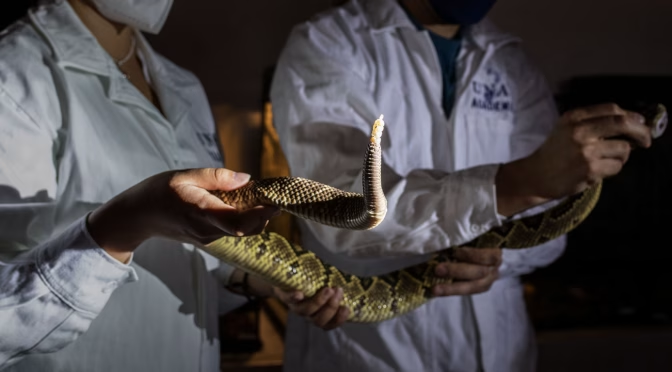
Three Mexican companies compete in this enterprise: Instituto Biocion, Inosan Biopharma, and BIRMEX, all headquartered in Mexico. They are aided by research conducted at the Institute of Biotechnology at Mexico’s National Autonomous University (UNAM), which houses a large herpetarium with over 60 species of venomous snakes from around the world. Each pharmaceutical company runs its own horse farms. One farm, the Ojo de Agua Ranch in Puebla, has over 160 Criollo horses; its work has received much publicity, but the production process appears similar throughout the industry.
The snakes are “milked” for their venom by electrical stimulation or by carefully guiding them to bite down on the porous cover of a specialized sterilized container. The venom naturally flows from the venom glands into the container and then is stored in vials for injection. Horses are injected with small doses of venom from multiple types of venomous snakes for approximately six months or until the antibodies produced in reaction to the venom reach a designated concentration. The horses are then periodically bled, removing several liters of blood. The antibody-rich plasma is separated from the rest of the blood, and the blood without the plasma is transfused back into the same horse. If you have ever donated blood or received a blood transfusion, you know that, except for the initial needle prick, this is a painless procedure.
Up to this point, antivenom production is carried out in much the same way it has been for over a century. However, the collected horse serum naturally contains, in addition to the desirable antibodies, components to which humans are allergic. So pharmaceutical companies conduct research and develop processes for ridding the serum of components that produce negative reactions in humans. The process has reached the point where the ever-vigilant US FDA has approved several products.
Other research being carried out by the current antivenom companies focuses on ways to enhance the shelf life and stability of antivenom medications, ways to standardize the amount of antibodies in a given dose, the mechanism through which the antibodies neutralize the toxicity of the venom, and perhaps in the near future, ways to produce the antivenom antibodies in vitro rather than using horses as an intermediate step. The companies are also studying the possibility of using some components of venom for treating diseases. For more about this, see the article in this issue by Kary Vannice.
Although Mexico is one of the leading countries in the production of antivenom, the best way to deal with venomous snake bites here is to avoid them. Pay attention to signs advising caution on hiking trails. Be aware that construction sites are disturbing indigenous critters and send snakes on the run (actually, a determined slither). And most snakes, venomous or not, are more likely to be on the move in the rain. If you have an encounter of the toxic kind, call for help to rapidly move you to the nearest health clinic and then thank the horse that provided you with lifesaving antibody-rich serum.