By Julie Etra
Huatulco’s electricity comes from a combination of sources—solar, hydroelectric, geothermal, and fossil fuels—but by far the largest contributor is wind. Think about it: have you ever seen any power-generating plants nearby?
La Ventosa
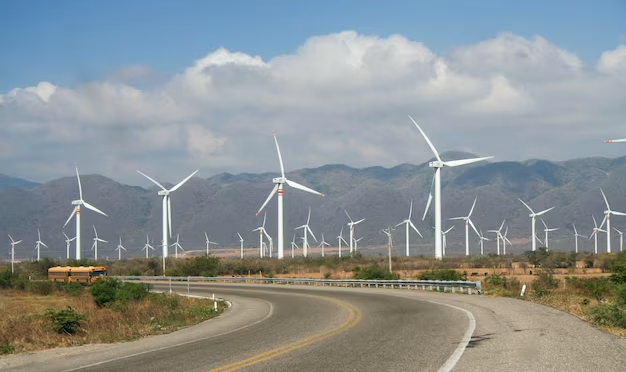
Huatulco gets almost all its power from the La Ventosa Wind Farm near the municipality of Juchitán de Zaragoza—its full name is Parque Eólico La Ventosa. The name makes sense, sort of: viento means wind, and ventosa translates to “windy” (or, as Google Translate might amusingly suggest, “sucker”).
This is one of the windiest stretches of highway in Mexico. Tractor-trailers are known to tip over in gusts reaching 90 km/h (55 mph). In February 2022, nine rigs rolled along this stretch of federal highway, and during a cold front in January 2025, gusts hit 110 km/h (68 mph).
These intense winds, locally known as El Tehuantepecer, Vientos Tehuanos, or Tehuantepecanos, originate north and east of the Isthmus in the Bay of Campeche on the Gulf of Mexico. They sweep southwest through the narrow Chivela Pass—at an elevation of just 225 meters (735 feet)—funneling and concentrating cool, dry air that collides with the hot air of the Juchitán region. This section of land is the second narrowest part of the Western Hemisphere, after Panama.
The wind farm consists of 104 turbines that generate 85 megawatts of electrical energy. Built by the Spanish company Iberdrola Renovables, it opened on November 10, 1994. Production has likely increased since Kathy Taylor, one of The Eye’s early writers, covered the project back in 2012 (www.theeyehuatulco.com/2012/01/01/going-green-in-huatulco). Of course, wind turbines aren’t maintenance-free. Regular inspections involve lubrication, cleaning, and repairs to gearboxes and electrical components.
For comparison, the Revolution Wind Farm off the coast of Rhode Island—built by Ørsted, a Danish government–majority-owned firm—will generate 400 MW for Rhode Island and 304 MW for Connecticut once completed. It will consist of 65 turbines located about 15 nautical miles offshore.
Solar Power
Although there are hot springs in the municipality of San Miguel del Puerto, Huatulco has no local source of geothermal power. Hydroelectric and fossil-fuel plants operate elsewhere in Oaxaca, feeding into the national power grid through substations.
Solar power, however, is a readily available and practical solution for those living off the grid—such as in Playa El Mojón. Electricity supplied by the federal government (Comisión Federal de Electricidad, or CFE) is expensive in Huatulco. The CFE billing system uses three tiers, with rates increasing as consumption rises. Once you exceed a higher tier, it takes several billing cycles of reduced use to return to the lower rate.
Casa Flores Bellas
In 2015, faced with Huatulco’s hot climate, the occasional sticky Tehuantepecers, and a sky-high third-tier power bill, we decided to install a solar system. Our system feeds energy back into the CFE grid, which credits us kilowatt for kilowatt on our bill.
The setup includes 14 panels and a Fronius IG Plus inverter, powering three A/C units, the refrigerator, and the pool pump (recently replaced with a more efficient model). Our contractor handled all the paperwork for the CFE tie-in.
The total generating capacity is 3,780 watts, with an average daily production of 15,120 watts. The cost of the photovoltaic generator and panels was $7,808.31 USD (at an exchange rate of 16.72 pesos per dollar), plus 10,000 pesos (about $600 USD) for the roof-mounted frame. We got two bids—the other was for 32,000 pesos for the frame—so we chose wisely.
We began the process soon after arriving on the coast in November 2015. The Fronius inverter, presumably imported from Austria, and the Chinese-made panels were delayed in arriving through the port of Salina Cruz. It took five months to complete and activate the system—waiting for parts, contractors, and, finally, the CFE hookup, which happened the day before we returned to the U.S.
In the end, it was one of the smartest decisions we’ve made. We rarely exceed our system’s capacity, and our bimonthly bill now averages just 45 pesos (about $2.50 USD).
Last year, we noticed construction of a small solar field in upscale Conejos but couldn’t find details on cost, permits, or end users. Driving around town, though, you’ll see solar panels popping up on many new rooftops.
Ironically, installing a similar system wouldn’t be cost-effective for us in sunny northern Nevada. Go figure. Go Mexico!