Tag Archives: solar

Where Does Huatulco Get Its Electricity?

By Julie Etra

Huatulco’s electricity comes from a combination of sources—solar, hydroelectric, geothermal, and fossil fuels—but by far the largest contributor is wind. Think about it: have you ever seen any power-generating plants nearby?

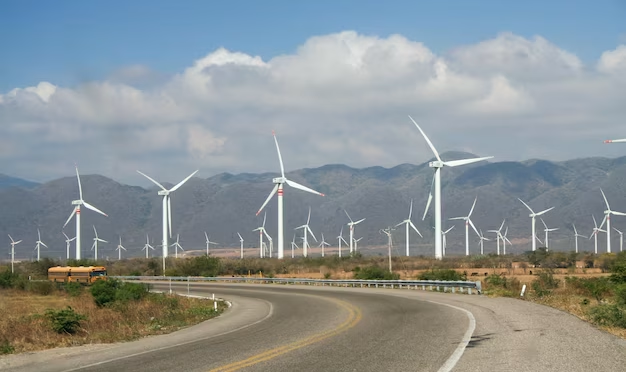
La Ventosa
Huatulco gets almost all its power from the La Ventosa Wind Farm near the municipality of Juchitán de Zaragoza—its full name is Parque Eólico La Ventosa. The name makes sense, sort of: viento means wind, and ventosa translates to “windy” (or, as Google Translate might amusingly suggest, “sucker”).

This is one of the windiest stretches of highway in Mexico. Tractor-trailers are known to tip over in gusts reaching 90 km/h (55 mph). In February 2022, nine rigs rolled along this stretch of federal highway, and during a cold front in January 2025, gusts hit 110 km/h (68 mph).

These intense winds, locally known as El Tehuantepecer, Vientos Tehuanos, or Tehuantepecanos, originate north and east of the Isthmus in the Bay of Campeche on the Gulf of Mexico. They sweep southwest through the narrow Chivela Pass—at an elevation of just 225 meters (735 feet)—funneling and concentrating cool, dry air that collides with the hot air of the Juchitán region. This section of land is the second narrowest part of the Western Hemisphere, after Panama.

The wind farm consists of 104 turbines that generate 85 megawatts of electrical energy. Built by the Spanish company Iberdrola Renovables, it opened on November 10, 1994. Production has likely increased since Kathy Taylor, one of The Eye’s early writers, covered the project back in 2012 (www.theeyehuatulco.com/2012/01/01/going-green-in-huatulco). Of course, wind turbines aren’t maintenance-free. Regular inspections involve lubrication, cleaning, and repairs to gearboxes and electrical components.

For comparison, the Revolution Wind Farm off the coast of Rhode Island—built by Ørsted, a Danish government–majority-owned firm—will generate 400 MW for Rhode Island and 304 MW for Connecticut once completed. It will consist of 65 turbines located about 15 nautical miles offshore.

Solar Power
Although there are hot springs in the municipality of San Miguel del Puerto, Huatulco has no local source of geothermal power. Hydroelectric and fossil-fuel plants operate elsewhere in Oaxaca, feeding into the national power grid through substations.

Solar power, however, is a readily available and practical solution for those living off the grid—such as in Playa El Mojón. Electricity supplied by the federal government (Comisión Federal de Electricidad, or CFE) is expensive in Huatulco. The CFE billing system uses three tiers, with rates increasing as consumption rises. Once you exceed a higher tier, it takes several billing cycles of reduced use to return to the lower rate.

Casa Flores Bellas
In 2015, faced with Huatulco’s hot climate, the occasional sticky Tehuantepecers, and a sky-high third-tier power bill, we decided to install a solar system. Our system feeds energy back into the CFE grid, which credits us kilowatt for kilowatt on our bill.

The setup includes 14 panels and a Fronius IG Plus inverter, powering three A/C units, the refrigerator, and the pool pump (recently replaced with a more efficient model). Our contractor handled all the paperwork for the CFE tie-in.

The total generating capacity is 3,780 watts, with an average daily production of 15,120 watts. The cost of the photovoltaic generator and panels was $7,808.31 USD (at an exchange rate of 16.72 pesos per dollar), plus 10,000 pesos (about $600 USD) for the roof-mounted frame. We got two bids—the other was for 32,000 pesos for the frame—so we chose wisely.

We began the process soon after arriving on the coast in November 2015. The Fronius inverter, presumably imported from Austria, and the Chinese-made panels were delayed in arriving through the port of Salina Cruz. It took five months to complete and activate the system—waiting for parts, contractors, and, finally, the CFE hookup, which happened the day before we returned to the U.S.

In the end, it was one of the smartest decisions we’ve made. We rarely exceed our system’s capacity, and our bimonthly bill now averages just 45 pesos (about $2.50 USD).

Last year, we noticed construction of a small solar field in upscale Conejos but couldn’t find details on cost, permits, or end users. Driving around town, though, you’ll see solar panels popping up on many new rooftops.

Ironically, installing a similar system wouldn’t be cost-effective for us in sunny northern Nevada. Go figure. Go Mexico!

Mexico’s Energy Crossroads: Can Sunshine Power the Future?

By Raveen Singh

How does Mexico keep the lights on? Unlike Canada, which generates most of its electricity from clean, renewable hydro power, Mexico relies heavily on fossil fuels. Hydroelectric opportunities are limited by topography, rainfall, and geography. As a result, natural gas has become Mexico’s workhorse — providing about 59% of the country’s electricity between August 2024 and July 2025.

Renewable sources — hydropower, solar, and wind — now supply roughly a quarter of Mexico’s power. While progress has slowed in recent years, the potential for alternate, cleaner, more secure energy remains enormous.

Where Mexico Gets Its Power

The Federal Electricity Commission (CFE), the state-owned utility, still dominates the sector. It is the only electricity provider for small and medium consumers and is legally required to maintain 54% of national power generation. Its mandate is to ensure stability in the National Electric System, but this dominance has made it difficult for private or foreign investors to enter the market.

Mexico’s National Electric System Development Program sets a bold goal: 50% clean energy by 2050. The vision is ambitious — the country’s geography offers abundant sunshine and strong winds — but the reality is more complicated. Recent policy shifts have favored fossil fuel expansion and reduced incentives for renewables. This has caused a slowdown in new solar and wind projects and concern among investors watching Mexico’s energy transition stall.

Hydropower: Limited by Landscape and Public Opinion

Hydropower may be clean and inexpensive once built, but it requires very specific conditions: a combination of terrain, consistent rainfall, and suitable geological foundations, work together for a viable project. Mexico’s geography and climate offer limited opportunities for such large-scale projects. Even where feasible, public opposition often arises over the flooding of valleys and the displacement of communities, not to mention historical land ownership issues that are prevalent.

Large dams also take years — sometimes decades — to plan and fund. A good example of how megaprojects can attract political interference and public distrust is seen with Canada’s SNC-Lavalin corruption scandals in the early 2000s.

Smaller “mini-hydro” installations have been developed across Latin America to minimize environmental impact, but they come at higher costs. Polaris Renewable Energy Ltd., a publicly-traded Canadian company operating in the region, shifted its focus toward solar after finding hydropower and wind developments slow and bureaucratic, as well as expensive and with a higher environmental disruption. As their executives put it, solar projects are simply faster, cheaper, and easier to deliver.

Wind Power: Promise in the Isthmus

Mexico’s southern Isthmus of Tehuantepec is among the windiest corridors in the Americas, making it the natural home for wind generation. The country currently has 87 onshore plants producing 8.67 GWh, with another 13 projects under construction. Yet few new ones are planned or approved.

The challenges are both technical and financial. Wind farms must be designed to withstand hurricanes and tropical storms — risks that drive up insurance and construction costs. Irregular wind patterns mean projects require storage or backup generation. Battery technology is improving but remains expensive and imperfect. And as climate change increases the unpredictability of weather patterns, long-term investors grow cautious.

For now, Mexico’s wind sector remains viable but uncertain — full of potential, short on momentum.

Solar Energy: The Bright Side

The clear winner in Mexico’s renewable race is solar power. With 85% of the country enjoying ideal conditions, sunlight is Mexico’s most abundant resource. Solar energy has expanded dramatically, from just 0.18 GW of installed capacity in 2016 to nearly 12 GW by 2024 — supplying 7.6% of national electricity.

Massive facilities such as the Villanueva Solar Plant in Coahuila (754 MW) and the Puerto Libertad complex in Sonora (405 MW) have positioned Mexico among the world’s leading solar power producing nations. If expanded strategically, solar power could meet more than half of the country’s energy demand within the next decade.

The benefits are obvious: reduced dependence on imported natural gas, lower emissions, and greater energy security.

The Obstacles to Going Solar

So, what’s holding Mexico back?
Despite its potential, building solar farms in Mexico costs more than the global average. Financing is expensive, supply chains are underdeveloped, and grid infrastructure is aging. Much of the national transmission system lacks redundancy, meaning a single failure can leave entire regions without power — as the two-day blackout across Yucatán and Quintana Roo in September 2025 demonstrated.

Solar power also requires major investment in energy storage to balance generation during cloudy days or nighttime hours. Without large-scale batteries and modernized transmission, much of Mexico’s sunshine will remain untapped potential.

Another challenge is policy. While the 2013 constitutional reform opened the energy sector to private and foreign investment, subsequent administrations have reasserted state control. This has made Mexico less attractive to international investors, even as global capital for renewables has surged elsewhere in Latin America.

Acciona: A Case Study in Renewable Investment

Spanish contractor Acciona Energía has been one of the most active foreign developers in Mexico, operating both wind and solar projects and building transmission infrastructure for the CFE. The company’s portfolio includes the 183-MW El Cortijo and 138-MW Santa Cruz wind farms in Tamaulipas, four wind projects in Oaxaca totaling over 550 MW, and the 405-MW Puerto Libertad solar complex in Sonora.

Acciona has also supported rural electrification through its non-profit arm, acciona.org, providing solar power to remote communities in Oaxaca and San Luis Potosí.

Yet even Acciona has signaled uncertainty. In August 2025, it announced a review of its entire Mexican portfolio as part of an “asset rotation process,” citing a tougher business environment. For Mexico — once considered a regional renewable leader — this retreat is a worrying sign.

The Road Ahead

Mexico has pledged to reach 45% clean energy by 2030 and 50% by 2050. Achieving that will require streamlined permitting, modernized transmission lines, and predictable policy to attract both domestic and international investment.

Experts agree the sun offers Mexico its brightest opportunity. But technology alone isn’t enough — political will must align with the nation’s natural advantages. A modern, reliable grid could make Mexico a continental powerhouse of clean energy.

Until then, the country stands at an energy crossroads: one road leading deeper into fossil fuel dependence, and another toward a self-sustaining, solar-powered future.

Acciona’s Renewable Projects in Mexico
Owned Wind Farms
· El Cortijo (Tamaulipas) – 183 MW, commissioned 2018
· Santa Cruz (Tamaulipas) – 138.6 MW, commissioned 2020
· Oaxaca Complex – Four farms totaling 556.5 MW
Wind Farms Built for Clients
· Ventika Complex (Nuevo León) – 252 MW
· Mesa La Paz (Tamaulipas) – 306 MW
Solar Projects
· Puerto Libertad (Sonora) – 405 MWp, joint venture with Tuto Energy
· Supreme Court Building (CDMX) – 1,000 m² of PV panels providing 12% of power
Transmission Projects for CFE
· Empalme II Grid (Sonora/Sinaloa) – 117 km
· Topolobampo III Lines (Sinaloa) – two lines and two substations
Rural Electrification
· acciona.org projects bringing solar home systems to low-income households in Oaxaca and San Luis Potosí