Tag Archives: istmus

Where Does Huatulco Get Its Electricity?

By Julie Etra

Huatulco’s electricity comes from a combination of sources—solar, hydroelectric, geothermal, and fossil fuels—but by far the largest contributor is wind. Think about it: have you ever seen any power-generating plants nearby?

La Ventosa
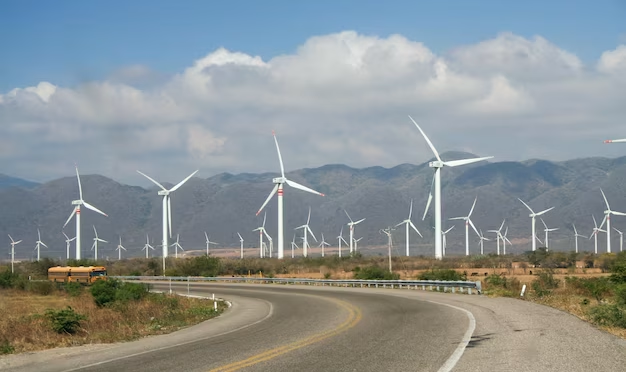
Huatulco gets almost all its power from the La Ventosa Wind Farm near the municipality of Juchitán de Zaragoza—its full name is Parque Eólico La Ventosa. The name makes sense, sort of: viento means wind, and ventosa translates to “windy” (or, as Google Translate might amusingly suggest, “sucker”).

This is one of the windiest stretches of highway in Mexico. Tractor-trailers are known to tip over in gusts reaching 90 km/h (55 mph). In February 2022, nine rigs rolled along this stretch of federal highway, and during a cold front in January 2025, gusts hit 110 km/h (68 mph).

These intense winds, locally known as El Tehuantepecer, Vientos Tehuanos, or Tehuantepecanos, originate north and east of the Isthmus in the Bay of Campeche on the Gulf of Mexico. They sweep southwest through the narrow Chivela Pass—at an elevation of just 225 meters (735 feet)—funneling and concentrating cool, dry air that collides with the hot air of the Juchitán region. This section of land is the second narrowest part of the Western Hemisphere, after Panama.

The wind farm consists of 104 turbines that generate 85 megawatts of electrical energy. Built by the Spanish company Iberdrola Renovables, it opened on November 10, 1994. Production has likely increased since Kathy Taylor, one of The Eye’s early writers, covered the project back in 2012 (www.theeyehuatulco.com/2012/01/01/going-green-in-huatulco). Of course, wind turbines aren’t maintenance-free. Regular inspections involve lubrication, cleaning, and repairs to gearboxes and electrical components.

For comparison, the Revolution Wind Farm off the coast of Rhode Island—built by Ørsted, a Danish government–majority-owned firm—will generate 400 MW for Rhode Island and 304 MW for Connecticut once completed. It will consist of 65 turbines located about 15 nautical miles offshore.

Solar Power
Although there are hot springs in the municipality of San Miguel del Puerto, Huatulco has no local source of geothermal power. Hydroelectric and fossil-fuel plants operate elsewhere in Oaxaca, feeding into the national power grid through substations.

Solar power, however, is a readily available and practical solution for those living off the grid—such as in Playa El Mojón. Electricity supplied by the federal government (Comisión Federal de Electricidad, or CFE) is expensive in Huatulco. The CFE billing system uses three tiers, with rates increasing as consumption rises. Once you exceed a higher tier, it takes several billing cycles of reduced use to return to the lower rate.

Casa Flores Bellas
In 2015, faced with Huatulco’s hot climate, the occasional sticky Tehuantepecers, and a sky-high third-tier power bill, we decided to install a solar system. Our system feeds energy back into the CFE grid, which credits us kilowatt for kilowatt on our bill.

The setup includes 14 panels and a Fronius IG Plus inverter, powering three A/C units, the refrigerator, and the pool pump (recently replaced with a more efficient model). Our contractor handled all the paperwork for the CFE tie-in.

The total generating capacity is 3,780 watts, with an average daily production of 15,120 watts. The cost of the photovoltaic generator and panels was $7,808.31 USD (at an exchange rate of 16.72 pesos per dollar), plus 10,000 pesos (about $600 USD) for the roof-mounted frame. We got two bids—the other was for 32,000 pesos for the frame—so we chose wisely.

We began the process soon after arriving on the coast in November 2015. The Fronius inverter, presumably imported from Austria, and the Chinese-made panels were delayed in arriving through the port of Salina Cruz. It took five months to complete and activate the system—waiting for parts, contractors, and, finally, the CFE hookup, which happened the day before we returned to the U.S.

In the end, it was one of the smartest decisions we’ve made. We rarely exceed our system’s capacity, and our bimonthly bill now averages just 45 pesos (about $2.50 USD).

Last year, we noticed construction of a small solar field in upscale Conejos but couldn’t find details on cost, permits, or end users. Driving around town, though, you’ll see solar panels popping up on many new rooftops.

Ironically, installing a similar system wouldn’t be cost-effective for us in sunny northern Nevada. Go figure. Go Mexico!

A Land in Between: The Istmo de Tehuantepec

By Randy Jackson

If you were to drive east from Huatulco for about two hours, you’d arrive at a narrow neck of land where the Pacific and Atlantic oceans nearly meet. You’ll know you’re there when you see a landscape covered by hundreds of windmills and feel and hear the force of wind as it hurtles against your vehicle. These are the Tehuano Winds, born from the clash of cool northern air spilling down from the Gulf of Mexico and the rising heat of the Pacific. Channeled through the Chivela Pass in the Sierra Madre, they come roaring toward the coast, sometimes with the force of a hurricane.

This region, known as the Istmo de Tehuantepec, is one of the eight distinct regions of Oaxaca, and it’s known for far more than wind. It’s a crossroads in every sense: a cultural crossroads between the heartlands of ancient Mesoamerican civilizations, an ecological crossroads bridging diverse geographical zones, and now, with the Interoceanic Corridor project, a potential crossroads for global trade.

Ecological Crossroads

The Istmo de Tehuantepec is an ecological crossroads. While the southern portions near the Pacific are dry and windswept, the northern reaches include part of Mexico’s largest tropical rainforest, the Selva Zoque, home to much of the nation’s biodiversity. This varied topography also gives rise to pine-oak forests and more than 300 species of native orchids.

The Istmo holds an extraordinary range of ecosystems within this relatively narrow band of land. There are cloud forests in the Sierra Madre, coastal lagoons along the Gulf of Mexico, and everything in between. Its geographic position bridges the flora and fauna of North and Central America, creating a vital migratory and evolutionary corridor where species from different regions meet, interact, and adapt.

Cultural Crossroads

For millennia, the Istmo de Tehuantepec has served as a crossroads between the heartlands of the Mesoamerican civilizations. The first of these civilizations was the Olmec, widely recognized for their iconic colossal stone heads. Their civilization was centred just to the north of the Istmo in the lowlands of the Gulf of Mexico. Later, as the Olmec declined, the Zapotec civilization emerged in the Valley of Oaxaca.

Archaeological finds suggest trade between these two civilizations, with goods like obsidian and jade traversing the Istmo between these two powers. Trade also existed in later times between the Maya civilization, located south and east of the Istmo, and the formidable city-state of Teotihuacán in the valley of Mexico.

Today, the Zapotec are the principal indigenous group of the Istmo, and their identity here is distinct. The Zapotec language in the Istmo differs significantly from the version in the Valley of Oaxaca. There are also cultural differences, such as the matrilineal social structures in the Istmo compared to the more patriarchal structures of the Zapotec of the Valley of Oaxaca. Other indigenous groups in the region of Istmo de Tehuantepec are the Mixe, roughly centred around the area of Matías Romero, and the Huave (they call themselves the Ikoots), located around San Mateo del Mar on the Pacific coast.

Global Crossroads – Mexico’s Interoceanic Corridor

Among the defining projects of former president Andrés Manuel López Obrador (AMLO), the Interoceanic Rail Corridor may turn out to be the most transformative. Beyond the potential benefits to Mexico overall, the state of Oaxaca, particularly the Istmo de Tehuantepec, could develop into an economic engine. Spanning 303 kilometres (188 miles), this rail link connects the Pacific port of Salina Cruz in Oaxaca with the Gulf port of Coatzacoalcos in Veracruz. Its aim is ambitious: to serve as a land-based alternative, or complement, to the Panama Canal, allowing cargo to be offloaded at one coast, transported swiftly across the Istmo, and reloaded on the other side.

The corridor project aims to stimulate industrial growth in southern Mexico through major infrastructure upgrades, chief among them the modernization of the Salina Cruz and Coatzacoalcos seaports. To draw private investment, the federal government plans to establish ten industrial parks along the route, offering tax incentives to companies willing to build and operate there.

The project is well underway. The expanded seaports are already under construction, and the rail line now has limited passenger service between the two coasts. One of the most high-profile developments tied to the corridor came in December 2024, when President Claudia Sheinbaum announced a $10 billion USD green hydrogen facility to be built by Helax, a subsidiary of Copenhagen Infrastructure Partners. Scheduled for completion in 2028, the project signals a push toward sustainable industry in the region.

If fully realized, the Interoceanic Corridor could mark a historic shift in Mexico’s economic geography, channeling investment and opportunity toward the poorer southern states of Oaxaca and Chiapas. The road ahead, however, isn’t without obstacles: land disputes, environmental concerns, and questions about who truly benefits, especially among local Indigenous communities.

For centuries, the Istmo de Tehuantepec has stood at the intersection of movement and change – a crossroads where two oceans, multiple climate zones, and cultures converge. The Istmo continues in its role as a landscape of transition and is now, possibly, a passageway for global trade.

For contact or comment: box95jackson@gmail.com.