Tag Archives: leon

Letter from SMA

By Ximena Collado—

It’s the start of a new year.
This issue has me thinking about new beginnings. Beginnings can be exciting and scary. How do you know when it’s time to start something new? Not everyone has the privilege of starting something new by choice, but for those fortunate enough who do, how can they know?

Enthusiasm toward the desired change must be greater than the comfort of staying where you are now. Comfort can be a beautiful place, but when it starts to quiet your curiosity, it may no longer be serving you. Enthusiasm, on the other hand, carries movement. It propels you forward.

But enthusiasm is not always comfortable. One of the ideas I return to often, inspired by the semiological approach of Alfonso Ruiz Soto, is that what is true is not always what is easy. Real enthusiasm does not necessarily feel light or effortless. It can coexist with fear. It can appear alongside grief for what is being left behind. It can even exist without the approval or understanding of those around you.

And yet, it remains.That persistence is what differentiates enthusiasm from impulse or passing emotion. An impulse burns fast and disappears just as quickly. Semiological enthusiasm stays. It returns quietly, again and again, even when doubt is present. Even when the path is unclear. Even when staying where you are would be simpler.

Enthusiasm is not a promise of ease or success. What it offers instead is direction. It functions as a compass, not a map. It doesn’t explain every step, but it consistently points somewhere meaningful.

So how do you know what to start? Follow what genuinely enthuses you—not only what excites you in the moment, but what continues to call your attention over time. Follow what feels alive, even if it feels inconvenient. Often, clarity does not come before movement. It comes after the first small step, once you allow yourself to begin.

Thank you tosome of the people who have helped me and opened their doors to me with this new project.

Roger Jones, our dear family friend, who always takes the time to welcome us at his breakfast table at his beautiful boutique hotel, Casa Angelitos.

Susana Alonso, an incredible glass artist with whom I spent hours talking at her studio and who made me feel completely at home.

Mike Solof, one of our incredible writers, who simply brings me so much joy.

To everyone who is reading this issue and who read the previous one, thank you. I wish you a beautiful start to 2026.Let’s start this Year of the Horse with strength, fire, and enthusiasm.

See you in February,
Ximena Collado

The Hidden City Behind the World’s Shoes

By Ximena Collado—

When I tell people I’m from León, they usually smile politely and ask, “Oh, where is that?” Few know that my hometown, tucked right in the heart of Mexico, is actually considered the shoe capital of the world. Not just of the country — of the world.
Not many people think of León as a tourist destination, even though it has a rich culture and great food. Yet it’s one of the closest airports to San Miguel de Allende, so countless travelers who fly in to visit San Miguel arrive through León. Many have unknowingly taken their first step in Guanajuato right here — in the city where the shoes they wear might have been made.
For those of us who grew up here, leather is more than a material; it’s part of our identity, the scent that lingers in the air, the texture of our childhood memories, the heartbeat of our city.
Some of my earliest memories are filled with that smell — the deep, warm leather that seemed to live in every corner of my house. My uncles worked with leather, crafting boots by hand in small workshops scattered across the city. When they hugged me after a long day, they always smelled like leather — rich and earthy, a scent that clung to their clothes and hands. To this day, whenever I catch that smell, it feels like home.
Walking through León, it’s impossible not to feel that connection. The smell of tanned leather still floats from old factories, and the markets shine with beautifully crafted boots and bags.
Our story with leather reaches back to the early 1600s, when León’s artisans began tanning hides and crafting goods by hand. The abundance of cattle in the Bajío region provided plenty of raw material, and the city’s location made it a natural hub for trade. Local histories suggest that Spanish settlers introduced new tanning methods during colonial times, techniques that blended with the skill and ingenuity of local craftspeople. Over the centuries, those small workshops grew into a thriving industry — and with it came a new identity. People from León earned the nickname panza verde, or “green belly,” a name said to come from the dyes and pigments that stained the aprons and skin of the leather workers. Over time, panza verde became more than a nickname; it became a badge of pride, a symbol of the color and character that define our craft.

Today, León produces millions of pairs of shoes every year, from classic cowboy boots to modern sneakers and elegant heels. But what many people don’t realize is that some of the world’s most recognized brands are made right here. I’ve even known friends who produce shoes for brands like Sperry or Steve Madden, proof of how León’s craftsmanship quietly travels the world. Their global designs are brought to life by Mexican hands — by people who’ve learned the balance between precision and intuition, between tradition and trend. If you’re looking for some beautifully made leather shoes, start with local names like Bala di Gala, Flexi, Cuadra, Dante, or Perugia — each one rooted in León’s heritage of craftsmanship and quality.
I always smile when I travel and spot a pair of shoes in a store that I know came from León. There’s something magical about seeing a piece of your city walking around the world — quietly, beautifully, without most people even knowing where it was born.
But León isn’t just an industrial city anymore. It’s transforming into a creative hub, a place where design, fashion, and culture come together. In recent years, I’ve watched boutique studios, design schools, and concept stores pop up all around the city. Events like SAPICA — Latin America’s biggest leather and footwear fair — attract buyers, stylists, and designers from all over the world. León is redefining itself: still rooted in craftsmanship, but now looking boldly toward the future.

Letter from SMA

By Ximena Collado —

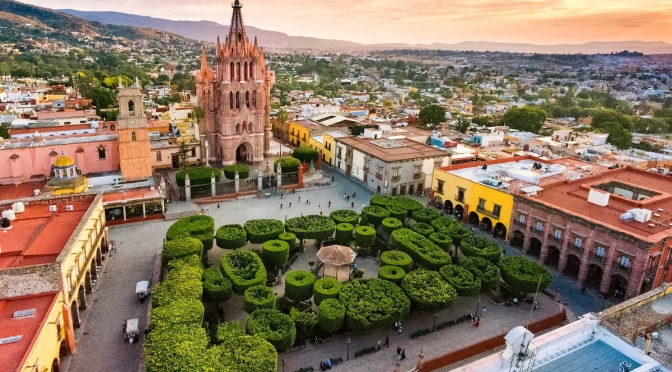
Welcome to the first edition of The Eye San Miguel de Allende. I have always connected to San Miguel and so, it felt natural, when my friend Jane, who I met at a two-week creative residency in Valle de Bravo told me she was looking to expand the magazine she had created more than 15 years ago in Huatulco to another city.

When I saw the advertising for this creative residency something told me I had to be there. I followed my intuition and promised myself I would come out of there with a project or idea I could execute. I knew this was the project I was looking for as soon as Jane and I started talking about it.

San Miguel is a city I hold close to my heart. When I was little, I came camping with my family and stayed at a trailer park close to the train rails. These trips to San Miguel were our beloved family vacations and they were the perfect combination of nature and town. My dad would give my siblings and I a 5- or 10-pesos coin, we would put it on the rails and wait for the train to pass. Our coins would become flat. We did that every time we came here on vacation.

Unfortunately, this trailer park doesn’t exist anymore. The land was sold, and I am told there are big houses built on that field now. I am trying to embrace change but the nostalgia hits me when I think of my childhood and the simple life. If anyone knows of a nice, simple place to go camping in San Miguel, please let me know.

We would always eat breakfast at Café La Parroquia where the lovely owner would greet us in what I thought was a fascinating accent. I think that’s where my curiosity for foreign languages and cultures started. She became the first “San Miguel local” I ever met. She was there every single morning. And she was so nice to us.

We hope this magazine can help many small businesses reach new clients as well as educate and inform you, our readers, about this beautiful country and city you are visiting or have decided to live in, and I’m so excited to immerse myself in this amazing town.

See you next month!
Ximena Collado