By Randy Jackson—
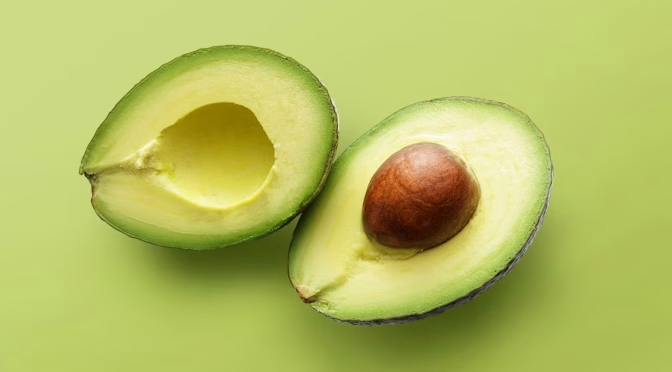
I’ve always known avocados to be cool. I have this memory of hearing an interview with John Lennon in which he was asked if he had tried them. I also happen to know when I first tasted them: 1986 at the World’s Fair in Vancouver, British Columbia. My own avocado story, however, is just a speck of dust compared with the fruit’s remarkable history.
Hip But Not New
Avocados are a fruit, and like most fruits, their survival has historically depended on the digestive systems of animals. Evolution’s system of seed dispersal is simple: an animal eats the flesh, carries the seed in its intestines, and deposits it elsewhere with a little natural fertilizer. But what kind of creature could swallow an avocado pit whole? Something big. Really big. Prehistorically big. Scientists have suggested that extinct megafauna, possibly including giant ground sloths and gomphotheres (prehistoric, trunked relatives of modern elephants), may once have dispersed avocado seeds. When these giant animals disappeared at the end of the last Ice Age, humans gradually took over the role of cultivating and spreading avocado trees.
By the time the Spanish Conquistadors arrived, there were already cultivated avocado orchards. The Aztec/Nahuatl word for the fruit was āhuacatl, which also happened to be slang for testicle. The Spanish mispronounced this as aguacate, which English speakers eventually warped into avocado.
But there were still centuries to go before the millennial breakfast of avocado toast was born. It took a California mail carrier accidentally cultivating the dark-skinned avocado most of us are familiar with today to truly change the game.
The Hass Accident
Rudolph Hass was a Milwaukee-born son of German immigrants. As a high school dropout seeking his fortune, he worked many jobs before becoming a mailman in Pasadena, California. Around that time, the Los Angeles Times ran an article about “the hanging gardens of Southern California,” noting that avocados could be grown on steep slopes where ordinary crops couldn’t. One magazine ad even featured dollar bills growing on avocado trees. So, in 1925, Rudolph bought into that dream by emptying his savings and borrowing money from his sister to acquire a 1.5-acre piece of land. Unable to afford established trees, he bought a handful of random seeds to start his own avocado grove, accidentally planting one that changed culinary history.

Rudolph quickly learned what every avocado grower knows: no two avocado trees produce the exact same fruit. Like a genetic lottery, any tree might bear watery, stringy, worthless fruit. The only way to reliably reproduce the variety you actually want is to graft a new tree from a cutting of a tree with desirable avocados. That was as true in Rudolph’s time as it is today.
The desirable avocado at the time was known as the Fuerte, a fruit proven able to withstand California’s cold snaps. Originally from Puebla, Mexico, it was the variety every grower wanted, and California growers grafted all their trees with a branch from a Fuerte tree. This, too, Rudolph Hass attempted to do. But one tree wouldn’t accept the graft and instead produced black, bumpy-skinned fruit. Rudolph’s children preferred the fruit from this rebellious tree, calling them the “ugly avocados.” They had a higher oil content and a richer, creamier flavour. This was the Hass avocado, which today dominates the international commercial avocado market.
Ripening and Marketing
Not yet, not yet, not yet… TOO LATE. This is the sentiment of most people looking to find a ripe avocado. Like all hip things, whether people or produce, the avocado is kind of a snob. It will not ripen while hanging from a branch and will just sit there for a year or more, unchanged. The avocado only begins to ripen once picked, and even then, it isn’t done making you wait.
For growers, the avocado tree is like a living warehouse. Once picked, though, the ripening clock starts, and timing becomes everything. This on-branch storage helps meet calendar-based demand, chief among them American Super Bowl parties, which would be incomplete without guacamole. In fact, the combined demand for guacamole around the Super Bowl, Cinco de Mayo, and the Fourth of July produces some of the largest spikes in U.S. avocado consumption.
But whether for guacamole or other culinary delights, nobody wants an unripe or overripe avocado. Because of this, there is a highly orchestrated process for getting an avocado to your grocery store in a state you’d actually be willing to pay three bucks for.
Once picked, they are chilled within hours to dramatically slow the ripening process. This allows up to four weeks for cold transport to reach grocery store distribution centers. The final ripening stage is then triggered by exposure to ethylene gas at the distribution center, ensuring the avocado reaches your grocery store primed to hit perfect ripeness within about a week.
Which leaves the last, most familiar stretch: standing in the produce section, squeezing avocado after avocado, divining each one’s readiness to eat. One final avocado factoid: once you get it home, putting it in the fridge will slow its final ripening by 80% to 90% compared to leaving it on the counter. Right to the end, the avocado does what it wants, when it wants.
The Millennial Breakfast
For me and many of my non-Mexican contemporaries, the avocado was unheard of until adulthood, arriving essentially when it became more widely available to North American consumers. Interestingly, its modern worldwide popularity has a lot to do with Australia, which is about as far from its historical Mexican origins as you can get. Australians actually originated the hippest avocado terms: smashed avo, smavo, avocado toast, and the Millennial breakfast.
Avocado toast gained mainstream popularity when Australian restaurateur Bill Granger introduced smashed avocado on toast at his Sydney café in 1993. He later included the recipe in one of his cookbooks, and it is widely regarded as the first published recipe for the now-iconic dish.
Gwyneth Paltrow raised its profile further with a recipe in her 2013 cookbook, and food bloggers and Instagram did the rest. Avocado toast got permanently tied to Millennials in 2016, when an Australian newspaper column went viral scolding young people for ordering $22 smashed avocado on toast instead of saving for a house deposit. This meme permanently solidified avocado toast as the definitive Millennial breakfast.
Hardly an early adopter, I had my first avocado toast years later in Huatulco, inadvertently bringing my personal avocado history full circle back to its Mexican roots. And how fitting that, as I finish writing this story from cooler northern lands, far from the nearest avocado tree, I’m happily munching on smavo on a toasted bagel for breakfast.
Randy Jackson blends local reporting from the perspective of a seasonal Huatulco resident with explorations of life and change in Huatulco, Oaxaca and Mexico. Email: box95jackson@gmail.com
Keep Exploring Mexico
Get your free Passport to Mexico and start checking off 100 unforgettable experiences.
Download the Passport → Click Here
Discover more from The Eye Mexico
Subscribe to get the latest posts sent to your email.