Tag Archives: Mexican Cuisine

The Sacred Kernel: A 10,000-Year Dialogue with Oaxacan Maize

By Nancy Reyes—

Mexico is often misunderstood by those looking in from the outside. For many, the country exists as a postcard: bright colors, mariachis on every corner, sombreros, tequila, and an endless fiesta. This image has become so exaggerated that it often borders on parody, reducing a land of immense depth to a handful of clichés. But as we at The Eye strive to show, the reality is much more layered. To truly understand the soul of Mexico—and specifically the enduring spirit of Oaxaca—one must look past the surface of the sun-drenched beaches and into the steaming clay pots of its kitchens. There, you will find the absolute foundation of daily life: corn.

If we trace the history of the peoples of this region by the domestication of maize 10,000 years ago, we would see a culture that spent millennia as Zapotec, Mixe, or Nahua long before the concept of “Indian” or “Indigenous” was imposed by colonial hierarchies. This is not just a crop; it is a living expression of geography, agriculture, and tradition. To understand why corn is considered sacred, one must look at the ancient stories that still resonate in the collective memory of the land.

The Legend of Corn: Quetzalcoatl’s Ingenuity

Before the arrival of the Spanish, according to an Aztec legend, the people fed only on the roots of plants and the animals they managed to hunt each day. Their greatest desire was to eat corn, but the golden grain grew hidden behind high, steep mountains that were impossible to cross.

The people begged the gods for help. Many of the deities, wanting to show their power, tried to separate the gigantic mountains using brute strength. They pushed and pulled with all their might, but the peaks would not budge. Time passed, and the people grew desperate. They turned to the great god Quetzalcoatl, begging him to find a way to reach the corn so they could make food to sustain their children.

Quetzalcoatl, unlike the other gods, did not want to rely on strength alone. He was a god of intelligence and ingenuity. He watched the mountains and noticed the tiny creatures that moved through the smallest crevices. To the amazement of the people, Quetzalcoatl transformed himself into a small black ant.

Without wasting a moment, he invited a red ant to accompany him on the arduous journey. For days, the two tiny insects climbed the steep, jagged slopes until they reached the snowy summit. Exhausted but determined, they descended the other side, and there they found them: the golden ears of corn the people so longed for.

They approached the most appetizing ear and extracted a single yellow kernel. Together, they began the return journey, holding the sun-colored grain firmly in their tiny mandibles. The return was even more exhausting; the load was incredibly heavy for their small bodies, and their legs buckled with every step. Yet, they refused to lose that precious cargo.

When they finally arrived back, breathless and nearly crawling, the Aztecs welcomed them with a great celebration. Quetzalcoatl gave the grain of corn to the people who rushed to plant it with immense care. In a short time, the first plant sprouted, followed by many others that eventually populated the fields. From then on, the Aztecs were able to feed their children, who grew up healthy and strong. In gratitude, they began to worship Quetzalcoatl, who became their most beloved god for all time.

The Marvel of the Tortilla

This legend mirrors a deeper truth: the survival of the Mexican people has always depended on a symbiotic relationship with nature. For thousands of years, indigenous communities refined maize varieties adapted to the region’s unique climates and soils. But the true brilliance lies in the ancient technological achievement known as nixtamalization.

By soaking the dried corn in an alkaline solution (usually water mixed with lime or wood ash) before grinding it into masa, ancient cultures transformed a simple grain into a far more nutritious and sustaining food. This process makes niacin more bioavailable, increases calcium, and improves the nutritional value of the corn. From this masa comes the tortilla, the foundation of daily life throughout Mexico.

Visitors to Oaxaca are often surprised by the sensory shift of a true handmade tortilla. Unlike the uniform, flattened versions found in supermarkets, fresh masa pressed and cooked on a hot comal produces a tortilla that puffs slightly, releasing a warm, toasted aroma of the earth itself. It is a small, quiet moment that reveals how deeply food and culture are intertwined.

This commitment to the land is also reflected in a philosophy of wasting nothing. Leftover tortillas are not discarded; they are transformed into chilaquiles, a beloved breakfast dish where corn chips (totopos) are coated in salsa and topped with cream and cheese. It is a celebration of creativity and respect for what we already have.

In Mexico, we have a beloved saying: “Panza llena, corazón contento”—a full belly makes for a happy heart. As you navigate the diverse and complex flavors of our region, I hope you discover more than just a meal. May you leave with a deeper appreciation for the land, the people, and the traditions that continue to shape Oaxaca today.

Nancy Reyes is a writer, teacher, and passionate advocate of Mexican culture.

Nancy’s Top Three Places to Eat
To help you navigate this rich landscape, here are my personal recommendations for a meaningful culinary connection in our region:

El Sabor de Oaxaca (La Crucecita, Huatulco) Located just off the main square, this family-run restaurant has been a trusted bridge to authentic flavors since 1994. It is my favorite spot for a traditional meal where the heritage of Oaxaca is served with pride. Whether you are trying their deep, dark mole or handmade tortillas, you are tasting a story of consistency and local love.

Entre Tierras (Huatulco) For those seeking deeper immersion, I recommend this intimate 8-course culinary adventure. Each course is crafted by Chef Jane Bauer using local ingredients shaped by the seasons. Held on Friday nights at the Chiles & Chocolate Cooking School, this dinner is not just a meal; it is a quiet story of land, labor, and migration. http://www.entretierrashuatulco.com

Casa Semilla (Pluma Hidalgo) When the coastal heat builds and you need a change of pace, head an hour up into the mountains to Pluma Hidalgo. Start your day at Casa Semilla, a community hub known for its freshly roasted high-altitude coffee and healthy meals made with local ingredients. Their commitment to disability inclusion and nourishment makes every bite feel like part of a larger, positive movement in the Sierra Madre del Sur.

Holy Guacamole: The Unexpected History of the Avocado

By Randy Jackson—

I’ve always known avocados to be cool. I have this memory of hearing an interview with John Lennon in which he was asked if he had tried them. I also happen to know when I first tasted them: 1986 at the World’s Fair in Vancouver, British Columbia. My own avocado story, however, is just a speck of dust compared with the fruit’s remarkable history.

Hip But Not New
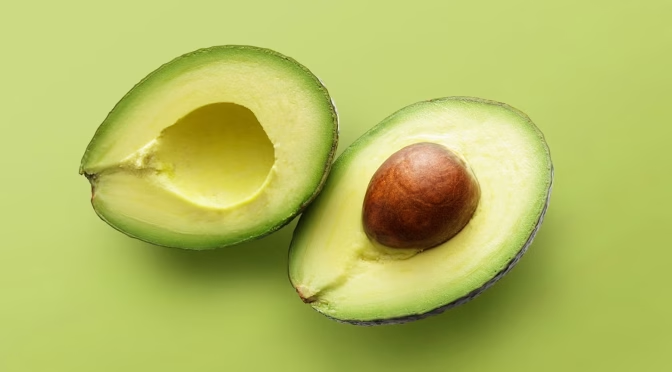
Avocados are a fruit, and like most fruits, their survival has historically depended on the digestive systems of animals. Evolution’s system of seed dispersal is simple: an animal eats the flesh, carries the seed in its intestines, and deposits it elsewhere with a little natural fertilizer. But what kind of creature could swallow an avocado pit whole? Something big. Really big. Prehistorically big. Scientists have suggested that extinct megafauna, possibly including giant ground sloths and gomphotheres (prehistoric, trunked relatives of modern elephants), may once have dispersed avocado seeds. When these giant animals disappeared at the end of the last Ice Age, humans gradually took over the role of cultivating and spreading avocado trees.
By the time the Spanish Conquistadors arrived, there were already cultivated avocado orchards. The Aztec/Nahuatl word for the fruit was āhuacatl, which also happened to be slang for testicle. The Spanish mispronounced this as aguacate, which English speakers eventually warped into avocado.

But there were still centuries to go before the millennial breakfast of avocado toast was born. It took a California mail carrier accidentally cultivating the dark-skinned avocado most of us are familiar with today to truly change the game.

The Hass Accident
Rudolph Hass was a Milwaukee-born son of German immigrants. As a high school dropout seeking his fortune, he worked many jobs before becoming a mailman in Pasadena, California. Around that time, the Los Angeles Times ran an article about “the hanging gardens of Southern California,” noting that avocados could be grown on steep slopes where ordinary crops couldn’t. One magazine ad even featured dollar bills growing on avocado trees. So, in 1925, Rudolph bought into that dream by emptying his savings and borrowing money from his sister to acquire a 1.5-acre piece of land. Unable to afford established trees, he bought a handful of random seeds to start his own avocado grove, accidentally planting one that changed culinary history.

Cover of The Eye's Passport to Mexico, a free guide featuring 100 unforgettable travel experiences across Mexico, including food, culture, nature, beaches, and adventure.
Download your free Passport to Mexico and start checking off 100 unforgettable experiences across Mexico. Click the cover to get your copy.

Rudolph quickly learned what every avocado grower knows: no two avocado trees produce the exact same fruit. Like a genetic lottery, any tree might bear watery, stringy, worthless fruit. The only way to reliably reproduce the variety you actually want is to graft a new tree from a cutting of a tree with desirable avocados. That was as true in Rudolph’s time as it is today.

The desirable avocado at the time was known as the Fuerte, a fruit proven able to withstand California’s cold snaps. Originally from Puebla, Mexico, it was the variety every grower wanted, and California growers grafted all their trees with a branch from a Fuerte tree. This, too, Rudolph Hass attempted to do. But one tree wouldn’t accept the graft and instead produced black, bumpy-skinned fruit. Rudolph’s children preferred the fruit from this rebellious tree, calling them the “ugly avocados.” They had a higher oil content and a richer, creamier flavour. This was the Hass avocado, which today dominates the international commercial avocado market.

Ripening and Marketing
Not yet, not yet, not yet… TOO LATE. This is the sentiment of most people looking to find a ripe avocado. Like all hip things, whether people or produce, the avocado is kind of a snob. It will not ripen while hanging from a branch and will just sit there for a year or more, unchanged. The avocado only begins to ripen once picked, and even then, it isn’t done making you wait.

For growers, the avocado tree is like a living warehouse. Once picked, though, the ripening clock starts, and timing becomes everything. This on-branch storage helps meet calendar-based demand, chief among them American Super Bowl parties, which would be incomplete without guacamole. In fact, the combined demand for guacamole around the Super Bowl, Cinco de Mayo, and the Fourth of July produces some of the largest spikes in U.S. avocado consumption.

But whether for guacamole or other culinary delights, nobody wants an unripe or overripe avocado. Because of this, there is a highly orchestrated process for getting an avocado to your grocery store in a state you’d actually be willing to pay three bucks for.
Once picked, they are chilled within hours to dramatically slow the ripening process. This allows up to four weeks for cold transport to reach grocery store distribution centers. The final ripening stage is then triggered by exposure to ethylene gas at the distribution center, ensuring the avocado reaches your grocery store primed to hit perfect ripeness within about a week.

Which leaves the last, most familiar stretch: standing in the produce section, squeezing avocado after avocado, divining each one’s readiness to eat. One final avocado factoid: once you get it home, putting it in the fridge will slow its final ripening by 80% to 90% compared to leaving it on the counter. Right to the end, the avocado does what it wants, when it wants.

The Millennial Breakfast
For me and many of my non-Mexican contemporaries, the avocado was unheard of until adulthood, arriving essentially when it became more widely available to North American consumers. Interestingly, its modern worldwide popularity has a lot to do with Australia, which is about as far from its historical Mexican origins as you can get. Australians actually originated the hippest avocado terms: smashed avo, smavo, avocado toast, and the Millennial breakfast.

Avocado toast gained mainstream popularity when Australian restaurateur Bill Granger introduced smashed avocado on toast at his Sydney café in 1993. He later included the recipe in one of his cookbooks, and it is widely regarded as the first published recipe for the now-iconic dish.

Gwyneth Paltrow raised its profile further with a recipe in her 2013 cookbook, and food bloggers and Instagram did the rest. Avocado toast got permanently tied to Millennials in 2016, when an Australian newspaper column went viral scolding young people for ordering $22 smashed avocado on toast instead of saving for a house deposit. This meme permanently solidified avocado toast as the definitive Millennial breakfast.

Hardly an early adopter, I had my first avocado toast years later in Huatulco, inadvertently bringing my personal avocado history full circle back to its Mexican roots. And how fitting that, as I finish writing this story from cooler northern lands, far from the nearest avocado tree, I’m happily munching on smavo on a toasted bagel for breakfast.

Randy Jackson blends local reporting from the perspective of a seasonal Huatulco resident with explorations of life and change in Huatulco, Oaxaca and Mexico. Email: box95jackson@gmail.com

Keep Exploring Mexico

Get your free Passport to Mexico and start checking off 100 unforgettable experiences.

Download the Passport →  Click Here

Editor’s Letter

By Jane Bauer—

“Each food item in a typical U.S. meal has traveled an average of 1,500 miles….If every U.S. citizen ate just one meal a week (any meal) composed of locally and organically raised meats and produce we would reduce our country’s oil consumption by over 1.1 million barrels of oil every week.”
― Barbara Kingsolver, Animal, Vegetable, Miracle: A Year of Food Life

I live in a small village with a public address system where you still hear announcements like, “La señora Martínez tiene pollo a la venta.” These days there are fewer loudspeaker messages because most have moved to our community WhatsApp group. A typical post reads: “Hola, buen día. Ya les tengo a la venta los ricos tamales de frijol y chepil en el domicilio de la señora Mendoza.” It’s simply letting the neighborhood know that fresh tamales are ready and waiting at someone’s home.

Mexico is full of pop food stands. People sell bolis, sliced fruit, tacos, tamales, homemade bread, roasted chickens, and countless other foods. Economists call this the informal economy, but there is a misconception that “informal” means unregulated. As a restaurant owner, people often ask me whether businesses here need permits or pay taxes, as though selling food in Mexico is free from the bureaucracy found in the United States or Canada. It isn’t. Even street food vendors are typically required to obtain permits, licenses, and food safety training. What sets Mexico apart is not the absence of regulation—it is that we have not completely corporatized our food system.

This past May I was hiking the North Carolina section of the Appalachian Trail. The forest was magnificent, and there is no better way to reconnect with nature. But every time I left the trail to resupply, I was struck by how many hikers—and local residents—relied almost entirely on processed food. Frozen meals, convenience stores, and an endless parade of fast-food restaurants lining the highways have become the default way to eat.

The numbers are hard to ignore. The United States has an estimated 180,000 to 210,000 corporate fast-food restaurants, compared with just 35,000 to 45,000 in Mexico. McDonald’s alone has 13,706 U.S. locations, compared with only 380 in Mexico, more than 36 times as many.

Recently, I drove nearly 900 kilometers from Huatulco to San Miguel de Allende. Do you know how many corporate fast-food restaurants I passed? Not one.

Cover of The Eye's Passport to Mexico, a free guide featuring 100 unforgettable travel experiences across Mexico, including food, culture, nature, beaches, and adventure.
Download your free Passport to Mexico and start checking off 100 unforgettable experiences across Mexico. Click the cover to get your copy.

That contrast matters. The recent U.S. Cyclospora outbreak, linked to contaminated shredded lettuce and affecting more than 1,600 people across over 30 states, illustrates the vulnerability of highly centralized food systems. When a single supplier distributes food across an entire country, one contamination event can quickly become a national public health crisis. Efficiency and scale have their advantages, but they also create fragility.

A few weeks ago I watched a social media video of a woman planting dried beans from a bag of mixed bean soup. The comments were filled with people insisting it was illegal to grow them. Whether or not those claims were true almost didn’t matter—the instinctive assumption was that growing your own food had somehow become suspect.

So the next time you see someone selling fresh food from a cart, a folding table, or the front of their home, recognize that they are preserving something valuable. Every tamale, taco, loaf of bread, and bag of fresh fruit represents a food system that is local, decentralized, and deeply human. Plant a garden. Buy from your neighbors. Skip the drive-through. Real food, sold by real people, is more than a meal; it is a quiet act of revolution.

See you in October,

Jane

Keep Exploring Mexico

Get your free Passport to Mexico and start checking off 100 unforgettable experiences.

Download the Passport →  Click Here


Spice of Life: Unpacking the Heat of San Miguel de Allende

By Michael Solof—

San Miguel de Allende is not just a feast for the eyes with its cobblestone streets and stunning architecture; it’s also a culinary haven, especially when it comes to the use of spices. The history of spices in this region tells a story of cultural exchange and adaptation, revealing how local and international influences have shaped the way we experience flavor and heat in our food today.

I’ve got a lot of territory to cover in this month’s article. In researching the history and uses of both traditional and non-traditional spices in Mexican cuisine, I had the pleasure of speaking with Marco Masseroti, Owner and Executive Chef of Casa Nostra; Donnie Masterson, culinary entrepreneur and master chef behind several of the town’s dining establishments; and Chef Odin Camacho, an up-and-coming private chef and creative cooking instructor in Querétaro. All generously took time out of their busy schedules to share how they incorporate traditional spices into their cooking and how these ingredients continue to shape the evolving culinary landscape of central Mexico.

A Brief History of Spices in Mexico
Spices have played an essential role in Mexican cuisine since ancient times. Indigenous peoples, including the Aztecs and Maya, relied heavily on local spices and herbs for both flavor and medicinal purposes. Key ingredients in this early culinary tradition included chili peppers, vanilla, and cacao. When the Spanish arrived in the 16th century, they brought with them a host of spices from Europe, Asia, and Africa, including black pepper, cinnamon, and cloves. This melding of flavors helped shape what we now recognize as traditional Mexican cuisine.
In San Miguel, much of the heat in food comes from local chile varieties, each offering its own unique flavor profile.

Jalapeño: Widely recognized and used, jalapeños add a moderate level of heat to salsas and sauces.
Serrano: With a sharper bite, serranos are often used in dishes such as pico de gallo.
Chipotle: Smoked and dried jalapeños, chipotles lend a rich, smoky flavor to many traditional dishes.

Cover of The Eye's Passport to Mexico, a free guide featuring 100 unforgettable travel experiences across Mexico, including food, culture, nature, beaches, and adventure.
Download your free Passport to Mexico and start checking off 100 unforgettable experiences across Mexico. Click the cover to get your copy.

These peppers are frequently paired with other ingredients to create some of Mexico’s most beloved foods. One seasonal favorite is Chiles en Nogada, featuring poblano peppers stuffed with a mixture of meat and fruit, then topped with a creamy walnut sauce and pomegranate seeds. The balance of sweet, savory, and spicy flavors has made it both a local favorite and a symbol of Mexican culinary heritage.

Chef Marco Masseroti, who has been running Casa Nostra for more than eight years, specializes in Italian comfort food but has developed a deep appreciation for Mexican spices.

“I love spices like cumin and oregano that give a lot of flavor without adding a lot of heat from chilies,” he says. “Pasilla and Guajillo are two of my favorites to work with. All my spices are sourced locally. Many foreigners have the misconception that all chilies are spicy, but many are much more flavorful than they are hot. A typical mole can cook for over 24 hours, with countless ingredients and spices needed to get the flavor just right.”

Chef Donnie Masterson, who moved to San Miguel 24 years ago and is currently celebrating the 18th anniversary of his restaurant, The Restaurant, agrees.

“Two of my favorite spices are cumin and coriander seed,” he says. “I love cumin for its warmth and versatility, which work beautifully across so many cuisines. I often use it in rubs, especially for pork, because it brings a deep, earthy backbone to a dish. Coriander seed adds brightness and a slightly citrusy note that balances richer flavors. One dish where I use both is an albóndigas soup that my Mexican grandmother used to make. It’s a Mexican meatball soup layered with cilantro, jalapeños, cumin, and coriander, and it’s incredibly comforting and aromatic.”

Chef Odin Camacho sees spices as something even more profound.

“My passion stems from understanding that Mexican cuisine is deeply rooted in the intelligent use of spices, not just for their heat but for their complexity,” he explains.

“Throughout my training and professional experience, I’ve come to understand that spices are a language: each one tells a story of region, tradition, and technique. That narrative is what continues to inspire me.”

One of Odin’s favorite ingredients is smoked dried chiles, particularly Chilhuacle and Pasilla varieties.

“They add depth beyond just spiciness,” he says. “I like to lightly toast them to release their oils and then incorporate them into sauces, emulsions, or even modern applications like foams or reductions, creating multi-layered flavor profiles.”

He is also passionate about lesser-known regional ingredients such as Querétaro saffron.

“It adds a distinct earthy flavor and vibrant color. It’s fundamental in traditional dishes like Garbanzo en Amarillo, where its presence defines the dish’s identity.”

Signature Dishes Built on Spice
San Miguel’s culinary scene is rooted in traditional dishes that showcase Mexico’s remarkable spice heritage. While recipes vary from region to region—and often from family to family—certain dishes highlight the depth, complexity, and versatility of the spices that define Mexican cuisine.

Mole Poblano: Often referred to as Mexico’s national dish, mole is a complex sauce made from dozens of ingredients, including chiles, chocolate, nuts, seeds, and spices such as cinnamon and cloves. Every family has its own recipe, making each mole a unique expression of tradition.

Tacos al Pastor: A local favorite, these tacos feature marinated pork cooked on a vertical spit and served with onions, pineapple, and cilantro. The marinade typically contains a blend of spices that creates the dish’s distinctive sweet, savory, and slightly smoky flavor.

Tamales: Wrapped in corn husks and filled with everything from meats to sweet ingredients, tamales are a staple throughout Mexico. The masa itself is often seasoned with spices, adding another layer of flavor to this beloved comfort food.

For Chef Odin Camacho, the quality of the spices behind these dishes is every bit as important as the recipes themselves.

“Quality is everything,” he says. “A fresh, well-preserved spice can completely transform a dish, while a low-quality one flattens it. In Mexican cuisine, where preparations like moles or adobos depend on the complexity of spices, using high-quality ingredients is non-negotiable; it defines the final result.”

Odin believes innovation works best when it begins with a strong understanding of tradition.

“I always start with respect for tradition: the basic structure of the dish. Once that base is well constructed, I allow myself to reinterpret techniques or presentations. For example, I might maintain the classic spice profile of a mole but present it through modern textures or unexpected elements, creating a bridge between heritage and innovation.”

One dish that embodies this philosophy is his deconstructed Chiles en Nogada.

“The blend of spices in the filling—cloves, cinnamon, and pepper—creates a warm, aromatic base that contrasts with the freshness of the walnut sauce. By reinterpreting it with contemporary techniques, the spices become more present and intentional in every bite.”

Technique, he says, is essential.

“Toasting is fundamental, as it activates the essential oils and deepens the flavors. Grinding spices fresh is also key. I also use infusion techniques, incorporating them into fats or liquids to extract more complex nuances and integrate them harmoniously into the dish.”Chef Marco shares a similar philosophy when it comes to creativity in the kitchen.

“Techniques like fermenting garlic versus using regular garlic really help bring out exceptional layers of flavor,” he says. “I work closely with all my chefs, experimenting with different recipes, ingredients, and spices to create new dishes. I’m always on the lookout for new spices to try, both in our restaurant and at home. Every ingredient needs a reason to be on the plate.”

For Marco, spices do far more than season food.
“Spices are storytellers. They tell us about culture, how ingredients are used, how they are treated, and how they are grown. I don’t think there’s any end to blending traditional, centuries-old Mexican techniques with modern international cuisine. My Nonna probably would have killed me for mixing Cannelloni with Mexican meats, but I think it’s important to open new doors.”

Chef Donnie Masterson believes freshness is equally important.

“I always prefer buying whole spices and toasting and grinding them myself with a mortar and pestle. Freshness is everything. Spices lose their potency over time, so I try not to overbuy. Keeping them fresh makes a huge difference in the final dish.”

For Masterson, quality spices are often the difference between a good meal and a memorable one.

“The quality of your spices can completely make or break a dish. If your spices are old or stale, you’re not going to get the depth, aroma, or intensity you’re looking for. Fresh spices bring life to food; they create layers, complexity, and balance. Without that, even a well-executed dish can fall flat.”

Whether they are preserving centuries-old traditions or experimenting with new techniques and flavor combinations, San Miguel’s chefs share a common belief: spices are far more than a source of heat. They are an essential part of the stories, cultures, and traditions that continue to shape Mexican cuisine.

For visitors interested in exploring this world for themselves, a walk through Mercado Ignacio Ramírez, a cooking class, or simply a meal at one of the city’s many outstanding restaurants offers a delicious introduction to the flavors that have defined Mexico for centuries.

Michael Solof leads SMA Adventure Hound, a group which takes locals and newcomers to brunches and dinners at different restaurants every week and he also offers classes in the art of smartphone photography. You can contact him at WhatsApp +1-443-310-9214 for more info and to reserve.

You may enjoy these articles:

The French Food Connection

5 Kinds of Tacos—and When to Eat Them

Your Guide to Asian Delights in SMA

Keep Exploring Mexico

Get your free Passport to Mexico and start checking off 100 unforgettable experiences.
Download the Passport →  Click Here