Tag Archives: November 2025

The Memorable Green Stones of Mexico

By Marcia Chaiken —

Two brilliant green gemstones of Mexico etched themselves permanently in my memory over fifty years ago. They were the jadeite eyes of the Red Jaguar throne. Reached in the state of Yucatan by climbing upward and upward through claustrophobic passages inside the Temple of Kukulcan, aka El Castillo, in the center of the archeological Mayan site of Chichen Itza, the visitor eventually emerges from a dusky passage to see green eyes seemingly blazing.

Although these green stones seemed unique at the time, after many years of exploring artifacts from archeological digs around Mexico, I realized that green gemstones were prized among many pre-Columbian populations, whether Mayan, Olmec, Aztec or other cultures such as the Toltecs. Jadeite (sometimes confused with jade) was extremely valued by the Mayans, not only for the mineral’s beauty but for the belief in its spiritual properties. The color was thought to be an emanation from the God of Maize. By incorporating jadeite fragments into funeral masks, the intent was to close the gap between the earthly world and the world of the gods. And adorning oneself with jadeite objects, such as earspools, indicated the high status of the wearer.

Turquoise was the green gem preferred by the Aztecs. The stone was worked into a plethora of jewelry for priests and royalty, including necklaces, earrings, nose ornaments and bracelets. Ceremonial objects such as knife handles were also inlaid with turquoise by the Aztecs. Like the Mayans, the Aztecs believed that their green stones were integral to their cosmology and spiritual beliefs.

Emeralds, though very rare, were worn by the highest-ranking members of indigenous ruling classes of the Mayans, Toltecs and Aztecs. Montezuma reportedly wore emeralds in his first meetings with the Spanish invaders. These jewels were also thought to be sacred and imbued with spiritual power.

Although recent research has shown that the turquoise used by the Aztecs was derived from Mexican mines in the north of the empire, jadeite was mined in the area now designated as Guatemala. Emeralds were obtained through trade routes and originally mined in Columbia. In the relatively recent past, mining of greenstones became a thriving industry in the northern states as well as in Chiapas around San Cristobal. Today Mexican greenstone jewelry has widespread appeal, and the minerals used include turquoise, calcite, jadeite, malachite, and andradite. Malachite jewelry has become so popular that it has stimulated plastic imitations; buyers seeking malachite are instructed to finger possible purchases before paying since malachite always feels cool but the plastic imitations take on the temperature of the surrounding air.

One of the beautiful green stones that abounds in Oaxaca is not a gemstone at all but a rock formed from volcanic ash, cantera. Green cantara has been quarried, cut and carved since colonial days near Oaxaca City and used to construct buildings and furniture, pave roads, and provide walls.

So, when I think of green stones in Mexico, I not only remember the brilliant green eyes of the Red Jaguar but the soft green glow of the streets, cathedral and other historic areas of Oaxaca.

AI May Be the Headline, But Nature Is Still the Story

By Kary Vannice

2025 has been a year fixated on technology, artificial intelligence, and man-made machines. It seems not a day’s gone went by without some mention of AI, either as a “new hope” or an existential threat.

Some of this year’s headlines included: “Tech show features more robots and AI than ever before,” “AI Could Reshape Humanity — And We Have No Plan For It,” and “MI5’s director warns of autonomous AI systems evading human oversight.”

The world is captivated by how motherboards, chatbots, and microchips might define the next decade or two of life on Earth. And yet, with our eyes and attention focused on the inner world of AI, many seem to have forgotten that we still live on a planet of water, earth and sky.

Centuries — and even just a few decades — ago, humanity strove to explore and define the world around us by seeking to decode nature and uncover what it could teach us about our own humanity and this place we call home.

Our planet is still evolving and we are still making striking discoveries in the natural world. So, in case you missed them, here are some of 2025’s biggest discoveries in nature.

Earth’s Deepest Ecosystem Discovered Six Miles Below the Sea – Nature Magazine

Scientists documented thriving animal communities using methane/chemosynthesis more than 9,000 meters below the surface of the Pacific. These microbes possess biochemical adaptations that allow them to extract energy from compounds that are toxic to most life. The finding may help us harness deep-sea enzymes to process industrial waste, create cleaner fuels, or break down methane emissions.

The Earth’s Inner Core Is Changing Shape – ScienceAlert

New seismic data revealed that Earth’s inner core, long believed to be a static metal sphere, is actually changing shape. Scientists found that it’s slightly deforming, rotating, and even slowing in certain regions. This helps researchers understand how energy moves through the planet and how Earth’s magnetic field, tectonic motion, and heat flow interact. The discovery could improve forecasts of geomagnetic shifts that influence navigation systems, satellite operations, and even climate patterns.

New Giant Amazonian Tree Species Identified – Environment News

In the Peruvian Amazon, botanists identified Drypetes oliveri, a towering 35-meter tree that had gone unnoticed until now. With more than 7,000 tree species, the Amazon still holds secrets like this “hidden giant” — a reminder that protecting these trees is essential for global carbon storage and conservation.

The Discovery of a “Missing” Plant Enzyme – Nature

Scientists discovered a special plant enzyme that had been missing from one of nature’s most important chemical recipes. The enzyme, called iridoid cyclase, helps plants make compounds that protect them from bugs and disease. These newly identified compounds can now be used to create important medicines — including drugs that fight cancer and malaria. This missing piece in nature’s chemistry set could one day help save lives.

Plants Have Hidden “Wiring” That Helps Them Handle Stress – Nature

Researchers studying tomato plants found a new molecular “switch” that helps control the rate at which fruits ripen and how they cope with tough conditions like drought. This shows that even familiar crops still have hidden systems that help them survive when water is scarce or weather turns extreme. By understanding this new wiring, scientists can help farmers grow stronger, healthier plants that need fewer resources and can better adapt to a changing climate.

The “Woolly Devil” Plant Discovered in Texas Desert – National Public Radio

In Big Bend National Park, botanists identified a completely new genus and species of flowering plant, nicknamed the “Woolly Devil.” Covered in tiny hair-like glands similar to those in plants that produce powerful medicinal compounds, it could potentially lead to the development of new, nature-derived medicines. Its discovery in a well-studied national park is another reminder that unexplored biological potential still exists in plain sight.

In a world captivated by algorithms and automation, it’s easy to lose sight of the fact that we’re part of an ever-evolving ecosystem. And the more we uncover about Earth — from the shape-shifting core beneath us to the microscopic chemistry inside a leaf — the more we realize how little we actually know. The discoveries of 2025 remind us that nature is still alive, dynamic, and brimming with answers to questions we haven’t even begun to ask.

Artificial intelligence may help us build the future, but nature still holds the blueprint for how to live wisely on this planet. So, perhaps the real “new frontier” isn’t the one we’re coding in ones and zeros, but the one we’re still discovering beneath our feet.

Poker of Queens

By José Palacios y Román

Any time is a good time to bring together talents. Just as in ancient times, Alexandria gathered wise men in its library; beautiful Athens, thinkers and philosophers; Florence was the cradle of the Italian Renaissance with artists, political scientists, inventors; and so, more recently, Silicon Valley, with technologists and innovators…

In Huatulco, four talented local women who love the art of painting and who have come to paint through different paths will converge to exhibit half a dozen of their most recent works on Friday, November 14th at 6:30 p.m. at the Copalli Art Gallery in the Tangolunda hotel zone. Each one will present their own creative proposal, creating a synergy that fosters recognition, enjoyment, and reflection, sharing their most recent creations with the local population, seasonal residents, and visitors or tourists.

The four female figures resemble each other and join together to share the exhibition title “Poker of Queens,” a symbolic game where, like a Tarot deck, there are hidden messages, subtle intuitions, chance, and the connection to other realities. The conjunction of the painters: Edna Guzmán, Julieta Valadéz, Aranza León, and Alma Drew, each with her own unique style, offers original pieces with the healthy desire to come together and exhibit their paintings, carefully chosen for this art show.

With this first exhibition, the Copally Art Gallery inaugurates the 2025-2026 season of the Weekend Art Show series for three consecutive years. This edition focuses primarily on local artists. This time, the artists are Edna Guzmán, recognized for her extensive career; Julieta Valadéz, from a family of artists and expressive in her painting; Aranza León, trained in academia with great creative force; and Alma Drew, versatile in her proposals and tireless in her pictorial work.

The opening will feature live music by Ilhui LomeVal, a welcome cocktail, and the presence of the four artists for a shared love of art. Poker de Reinas will be on display from November 14th to December 6th, 2025.

Los Pream to Open the Winter Season of Amigos de la Música Huatulco

By Jesús López Aguilar

From Santa María Tlahuitoltepec and heirs to the Ayuujk Jää musical tradition, Los Pream is a collective of musicians whose artistic paths are as broad as they are diverse. Through their evolution, they have forged a new sonic identity rooted in the rhythmic foundations of the Mixe communities of Oaxaca’s Sierra Norte, blending these with improvisational elements from genres such as jazz, funk, Balkan, and suun.

The Mixe musicians — Vladimir Medina (keytar), Konk Balam (guitar), Mario Rubén Cardoso (trumpet), Andrés Vargas (trumpet), Facundo Vargas (trombone), Oscar Martínez (tuba), and Jonás Uriel (drums) — make up Los Pream. Most are conductors of philharmonic orchestras and accomplished composers who merge the musical traditions of their homeland with global sounds.

During their recent European tour, Los Pream performed with Africa Express, a project led by musician and producer Damon Albarn, best known for his work with Blur and Gorillaz. Critics praised the group for their bold and innovative fusion of sounds, as well as their electrifying performances and commanding stage presence.

In Albarn’s own words, following their performance at the 2024 Bahidorá Festival in Mexico: “We needed a brass band — something to strengthen the Africa Express show. Los Pream brought an essential sound throughout the entire performance and creative process… A group like theirs was exactly what the project needed.”

Los Pream embodies a rare fusion of tradition and innovation. Their music celebrates cultural diversity and creativity, offering a window into the evolving Ayuujk sonic identity.

They will open the Winter Season of Amigos de la Música Huatulco with a Gala Concert on December 6 at 7:00 p.m. at Hotel Dreams Huatulco. The concert will take place outdoors, in the seaside garden of this stunning venue.

Nothing Wasted: The Beauty of Leftovers

By Jane Bauer

I once met someone who told me their least favorite food was leftovers. When you hear the word leftovers, you might picture day-old pizza or a casserole that has overstayed its welcome. But leftovers can be the start of something delicious—far beyond simply heating them up for another round of the same old, same old.
Here are a few dishes that are enhanced by leftovers:

Leftover: Stale Bread
Solution: French Toast
In French, it’s called Pain Perdu—“Lost Bread.” I’ve always found the name poetic. It conjures an image of a piece of stale bread sitting on the counter of a Parisian apartment. This isn’t bread for the birds or the trash, it’s magic waiting to happen.

Crack an egg into a bowl, pour in a little milk, and add a dash of cinnamon or vanilla. Beat with a fork until blended. Slice your bread, then heat a frying pan and add just enough fat—butter or oil—to keep things from sticking.

Dredge the bread in the milk mixture until the outer layer absorbs some of the liquid—don’t let it get soggy. Fry until the slices turn a beautiful golden brown. Plate and drizzle with syrup.

Super hack: Have a jar of jam that’s been sitting in your fridge forever? Add the jam to a small saucepan with a bit of water. Simmer slowly, stirring until you have a warm jam sauce. Add more water as needed to reach your desired texture.

Leftover: Corn tortillas
Solution: Chilaquiles (a.k.a. Nachos for Breakfast)

One of the best Mexican breakfasts is, in essence, a celebration of leftovers. Tortillas are typically sold by the kilo—a lot for just a couple of people. You can wrap them in a dishtowel and place them in a plastic bag to stretch their life another day, but really, tortillas are best eaten fresh.

So what to do with the extras? Make totopos—corn chips. Cut the tortillas into quarters. Heat about an inch of vegetable oil in a saucepan. When it’s hot, drop in a few pieces and fry until firm, but not brown. They’ll continue cooking after you remove them, so if they’re already brown in the pan, they’ll end up overdone. Place on paper towels to drain.

Now you’re ready for chilaquiles. Heat about half a cup of your house salsa (because of course, you always have one). When it’s hot, toss in a handful or two of totopos, stirring gently until they’re coated in the sauce. Plate immediately—don’t let them linger or they’ll get soggy. Top with cheese, sliced onions, avocado, and a dollop of cream.

Salsa Roja
8 Roma Tomatoes
1 jalapeño
3 garlic cloves
½ teaspoon of salt
Roast or boil ingredients. Blend. Season to taste. For extra heat add a couple of chile de arbol (small dried chiles).

Leftover: Boiled or roasted potatoes
Solution: Bauernfrühstück (Farmer’s Breakfast)

My last name is Bauer and as a girl my father would often make this dish on Sunday mornings. This German dish is all about turning yesterday’s potatoes into today’s comfort food. —it’s a rustic skillet of fried potatoes, eggs, and whatever else is on hand.

Slice up your leftover boiled or roasted potatoes. Heat a generous spoonful of butter or oil in a frying pan, and toss in the potatoes until they start to crisp and brown at the edges. Add chopped onions, peppers, or bits of ham if you have them.When everything smells irresistible, pour in a few beaten eggs and let them set slightly before stirring. You want a balance between soft and crisp, not scrambled.

Season with salt and a generous amount of pepper, maybe a sprinkle of fresh herbs if you have some around.

Each of these dishes celebrates the beauty of using what’s left—transforming the forgotten and the stale into something comforting and new. A reminder that good food doesn’t begin with perfection. It begins with creativity, care, and respect for what we already have. In the kitchen, as in life, nothing needs to go to waste.

Jane Bauer is the owner/operator of Café Juanita and the Chiles & Chocolate Cooking School.

Best Books of 2025: Short Stories and Series

By Carole Reedy

A book is a device to spark the imagination.
Allan Bennet

In terms of Bennet’s observation, I found this year of reading disappointingly lacking. Each new season we seek a great read, but what exactly are we looking for?

Novels are rich in character development, have an engaging plot with vivid descriptions of the ambiance of period or place, and possess a distinct writing style. Well executed, these characteristics allow the reader to emotionally connect with the author’s themes, leading to reflection long after the final word is read.

In light of my general dissatisfaction (though a few novels made it into my forthcoming column), I turned to some other genres: the short story for one, as well as essays and series. Here I found the literary satisfaction I was seeking.

Savory Series
One might think a series is merely a collection of novels, but for the reader gratification relies on continuing character development along with detailed, continuing stories of the characters’ lives that cannot be achieved in a single volume.

The following five series, which will take you around the world, provide all of the elements needed for a deeply satisfying season of reading.

The Shetland Island Mysteries by Anne Cleeves
This remote and modest part of the world provides more action and richly developed characters than you might expect. The isolation of the islands and their harsh weather and barren landscape all play roles in the psyche of the population as well as providing an eerie ambiance.

I’m guessing you’ll get hooked on the characters, beautifully crafted throughout the series. Cleeves has a style and method that is simply compelling. Readers of the series have even been inspired to put the Shetland Islands on their travel list.

Cleeves has two other series to enjoy: the Vera Stanhope and Matthew Venn series. All three of Cleeves’ series have been adapted for TV.

The Leaphorn, Chee, and Manuelito Novels by Anne Hillerman
We are fortunate that Anne Hillerman’s mother and friends encouraged her to continue writing her father’s Navajo tribal police series.

The revered writer Tony Hillerman (1925-2008) and his fictional Navajo Nation detectives Joe Leaphorn and Jim Chee charmed mystery lovers in the 1970s, 80s,and 90s. Hillerman’s close field of vision of this Native American population contributed mightily to the popularity of the series. Through his deeply felt descriptions of Navajo culture, Hillerman brought us a new vision of the first Americans.

Anne Hillerman’s earnest effort to continue the series has been a wondrous surprise to fans. She has successfully added detective Bernadette Manuelito (Jim Chee’s wife) to the series, giving her room to be a forceful character in her own right. Manuelito’s relationship with her mother, sister, and Chee adds an exciting new element to the detective unit as well as to the personal lives of the old favorites.

The series re-creates the world of American native citizens of Arizona and New Mexico. The plot weaves in the age-old traditions and beliefs of the people of the southwest in a way that’s engaging and educational. The vivid imagery is so powerful it feels as though the dust might settle on your tongue.

The Sean Duffy Series by Adrian McKinty
McKinty’s hero arrives in the unlikely figure of Belfast Detective Sean Duffy, an independent thinker and rule breaker, not traits usually found in Ulster policemen.

But McKinty’s style is pure genius.

Even if you’re not personally connected to history’s violent political environment of Northern Ireland, the eerie atmosphere of the region and the affairs of the population will entrap you…and Sean Duffy will eventually charm you.

The Commissario Guido Brunetti Mysteries by Donna Leon
All 33 (so far) novels take place in the ethereal state of Venice, in the mysteriously diverse country of Italy, where detective Commissario Guido Brunetti leads a small group of police that attempts to solve myriad crimes in their district.

However, and this is key, the mysteries always entail more than simply a crime.

Leon gives us sharp glimpses into the social and practical aspects of daily Venetian life. Her characterizations, not only of the police and perpetrators but of Brunetti’s family, are brilliantly colorful in depth and intensity.

Societal and political issues and concerns of the city, as well as other parts of the country, lurk in the background of whatever crime the team is investigating. A few of the novels particularly impressed me with their richness of commentary on Venetian society and personal concerns: Willful Behavior, Friends in High Places, A Noble Radiance, and Uniform Justice.

The Ruth Galloway Novels by Elly Griffiths
It’s nearly impossible to write about favorite series without a shoutout to Elly Griffiths and her memorable archaeologist professor Dr Ruth Galloway, who analyzes buried bones found in Norwich.

Galloway inadvertently (or not) finds herself in the middle of various crime investigations when the bones her archeological students find are not centuries old, but newly emerged. And police investigations ensue.

The real joy in reading this series lies in Griffiths’ keen characterizations—of Dr Ruth Galloway, Detective Nelson, and the Druid Cathbad among others.

Satisfying Short Story Collections

Good and Evil and Other Stories by Samanta Schweblin, translated by Megan McDowell

Argentine writer Schweblin has already tasted success with her 2014 National Book Award-winning Seven Empty Houses. And now this, her latest, is receiving accolades from many sources, most importantly from the prolific Joyce Carol Oates in The New York Times Book Review.

Oates sums it up: “Beautifully translated by Megan McDowell, in prose that shimmers with a sort of menacing lyricism, the stories of ‘Good and Evil’ are powerfully evocative and unsettling. They seem to hover, indeed like fever dreams, between the reassuring familiarities of domestic life and the stark, unpredictable, visionary flights of the unconscious. Everything exists in a state of tension, charged with contradictions.”

Each story, though unique, possesses an unnerving surprise, never taking the expected path.

Dictation by Cynthia Ozick
Recommended by a fellow book club member, I immediately downloaded this quartet of stories. The mention of Henry James and Joseph Conrad as characters in the first story prompted my automatic interest.

Nonetheless, the stars of this short story are the women who take dictation from the masters. The finale is astonishing yet plausible. The other three stories, though without the notable characters of the first, are equally deserving of praise.

Part two of the Best Books of 2025 next month will offer a glimpse into the handful of novels I read in 2025 that satisfied my reading obsession.

Where Does Huatulco Get Its Electricity?

By Julie Etra

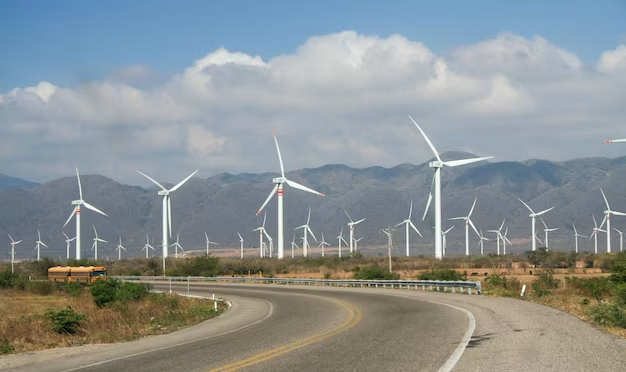
Huatulco’s electricity comes from a combination of sources—solar, hydroelectric, geothermal, and fossil fuels—but by far the largest contributor is wind. Think about it: have you ever seen any power-generating plants nearby?

La Ventosa
Huatulco gets almost all its power from the La Ventosa Wind Farm near the municipality of Juchitán de Zaragoza—its full name is Parque Eólico La Ventosa. The name makes sense, sort of: viento means wind, and ventosa translates to “windy” (or, as Google Translate might amusingly suggest, “sucker”).

This is one of the windiest stretches of highway in Mexico. Tractor-trailers are known to tip over in gusts reaching 90 km/h (55 mph). In February 2022, nine rigs rolled along this stretch of federal highway, and during a cold front in January 2025, gusts hit 110 km/h (68 mph).

These intense winds, locally known as El Tehuantepecer, Vientos Tehuanos, or Tehuantepecanos, originate north and east of the Isthmus in the Bay of Campeche on the Gulf of Mexico. They sweep southwest through the narrow Chivela Pass—at an elevation of just 225 meters (735 feet)—funneling and concentrating cool, dry air that collides with the hot air of the Juchitán region. This section of land is the second narrowest part of the Western Hemisphere, after Panama.

The wind farm consists of 104 turbines that generate 85 megawatts of electrical energy. Built by the Spanish company Iberdrola Renovables, it opened on November 10, 1994. Production has likely increased since Kathy Taylor, one of The Eye’s early writers, covered the project back in 2012 (www.theeyehuatulco.com/2012/01/01/going-green-in-huatulco). Of course, wind turbines aren’t maintenance-free. Regular inspections involve lubrication, cleaning, and repairs to gearboxes and electrical components.

For comparison, the Revolution Wind Farm off the coast of Rhode Island—built by Ørsted, a Danish government–majority-owned firm—will generate 400 MW for Rhode Island and 304 MW for Connecticut once completed. It will consist of 65 turbines located about 15 nautical miles offshore.

Solar Power
Although there are hot springs in the municipality of San Miguel del Puerto, Huatulco has no local source of geothermal power. Hydroelectric and fossil-fuel plants operate elsewhere in Oaxaca, feeding into the national power grid through substations.

Solar power, however, is a readily available and practical solution for those living off the grid—such as in Playa El Mojón. Electricity supplied by the federal government (Comisión Federal de Electricidad, or CFE) is expensive in Huatulco. The CFE billing system uses three tiers, with rates increasing as consumption rises. Once you exceed a higher tier, it takes several billing cycles of reduced use to return to the lower rate.

Casa Flores Bellas
In 2015, faced with Huatulco’s hot climate, the occasional sticky Tehuantepecers, and a sky-high third-tier power bill, we decided to install a solar system. Our system feeds energy back into the CFE grid, which credits us kilowatt for kilowatt on our bill.

The setup includes 14 panels and a Fronius IG Plus inverter, powering three A/C units, the refrigerator, and the pool pump (recently replaced with a more efficient model). Our contractor handled all the paperwork for the CFE tie-in.

The total generating capacity is 3,780 watts, with an average daily production of 15,120 watts. The cost of the photovoltaic generator and panels was $7,808.31 USD (at an exchange rate of 16.72 pesos per dollar), plus 10,000 pesos (about $600 USD) for the roof-mounted frame. We got two bids—the other was for 32,000 pesos for the frame—so we chose wisely.

We began the process soon after arriving on the coast in November 2015. The Fronius inverter, presumably imported from Austria, and the Chinese-made panels were delayed in arriving through the port of Salina Cruz. It took five months to complete and activate the system—waiting for parts, contractors, and, finally, the CFE hookup, which happened the day before we returned to the U.S.

In the end, it was one of the smartest decisions we’ve made. We rarely exceed our system’s capacity, and our bimonthly bill now averages just 45 pesos (about $2.50 USD).

Last year, we noticed construction of a small solar field in upscale Conejos but couldn’t find details on cost, permits, or end users. Driving around town, though, you’ll see solar panels popping up on many new rooftops.

Ironically, installing a similar system wouldn’t be cost-effective for us in sunny northern Nevada. Go figure. Go Mexico!

Bring Your Own Bottle: A Small Choice with a Big Impact

By Alicia Flores

When you come to Mexico on vacation, one of the easiest and most meaningful ways you can reduce your environmental impact is by bringing your own reusable water bottle. It may seem like a small gesture, but it can make a big difference.

Across Mexico’s coastlines, discarded single-use plastic bottles are one of the most common forms of litter. Many travelers, trying to stay hydrated, accept dozens of small water bottles throughout their stay—on excursions, in hotel rooms, and at restaurants. Unfortunately, most of these bottles end up in landfills or, worse, in the ocean.

By bringing your own bottle, you can help shift this pattern. Most restaurants, cafés, and hotels are happy to refill your bottle with purified drinking water if you simply ask. In fact, many properties now have refill stations or large garrafones (19-liter jugs) available for guests.If you’re staying at a large resort, do your part by politely declining small plastic bottles whenever possible. Instead, ask where you can refill your own. The more guests who make this simple request, the more hotels will prioritize refill options in the future.

Traveling responsibly doesn’t mean giving up comfort—it means being thoughtful about the small daily choices that add up. Bringing your own bottle is a simple way to stay hydrated, save money, and help protect the beautiful landscapes you came to enjoy.

Bottled water waste: The average traveler staying one week at an all-inclusive resort can easily go through 30–40 small plastic bottles of water. Multiply that by hundreds of guests, and a single hotel can generate thousands of bottles per week.

Global picture: An estimated 1 million plastic bottles are sold every minute worldwide, and less than 30% are recycled.

Ocean impact: Every year, 8 million tons of plastic enter the ocean—much of it from disposable food and drink packaging.

Refillable wins: A single reusable bottle can replace hundreds of disposables each year.

Travel Tip: If you plan to order takeout or eat on the beach, consider packing a reusable food container (a simple Tupperware works perfectly). Many local restaurants will happily pack your meal into your own container if you ask—it reduces waste and keeps your food fresher on the go.

El Sueño Zapoteco A.C. / Bacaanda Foundation: Smart Rural Schools That Transform Lives

By Britt Jarnryd

With nearly 17 years of uninterrupted work, El Sueño Zapoteco A.C. / Bacaanda Foundation works tirelessly to open paths of opportunity in the most vulnerable rural communities along the coast and in the southern Sierra of Oaxaca. Recognized as an authorized nonprofit organization in Mexico, the United States, and Canada, it is committed to a clear purpose: to provide children and young people with a dignified, equitable, and quality education.

Today, that dream has taken shape through the Smart Rural School project—an innovative initiative designed to strengthen learning in Spanish and mathematics by incorporating technology, ongoing teacher training, and educational mentorship as essential pillars. This comprehensive model combines digital tools, pedagogical development, and financial support for rural teachers, dignifying their work and reducing teacher turnover—one of the main challenges in rural areas.

The program’s goals include expanding meaningful learning, encouraging the use of technology in teaching, developing digital and socio-emotional skills, and ensuring that teachers remain in their communities. In addition, systematic evaluations track academic progress, guaranteeing continuous improvement in educational outcomes.

Each classroom is equipped with a smart screen, iPads (one for every two students), educational applications, satellite internet, and digital programs for Spanish and mathematics. Thanks to joint efforts and the commitment of our partners, all of our rural schools are now connected to satellite internet—opening the doors of knowledge to the world.

For the 2025–2026 school year, the program is being implemented in 52 rural schools, benefiting 57 teachers and more than 550 students. The results are evident: improved reading comprehension, stronger logical-mathematical thinking, more motivated teachers, and school communities strengthened by hope.Yet much remains to be done. We invite you to be part of this dream:Sponsor a school and transform the life of a community.

Contribute to the monthly cost of satellite internet that keeps the connection to learning alive.Support teacher training or sponsor a rural teacher, ensuring their development and permanence. Every donation plants the seeds of the future. Join El Sueño Zapoteco A.C. / Bacaanda Foundation and together let’s continue building an Oaxaca where education transforms lives and keeps dreams alive.


Mexico’s Energy Crossroads: Can Sunshine Power the Future?

By Raveen Singh

How does Mexico keep the lights on? Unlike Canada, which generates most of its electricity from clean, renewable hydro power, Mexico relies heavily on fossil fuels. Hydroelectric opportunities are limited by topography, rainfall, and geography. As a result, natural gas has become Mexico’s workhorse — providing about 59% of the country’s electricity between August 2024 and July 2025.

Renewable sources — hydropower, solar, and wind — now supply roughly a quarter of Mexico’s power. While progress has slowed in recent years, the potential for alternate, cleaner, more secure energy remains enormous.

Where Mexico Gets Its Power

The Federal Electricity Commission (CFE), the state-owned utility, still dominates the sector. It is the only electricity provider for small and medium consumers and is legally required to maintain 54% of national power generation. Its mandate is to ensure stability in the National Electric System, but this dominance has made it difficult for private or foreign investors to enter the market.

Mexico’s National Electric System Development Program sets a bold goal: 50% clean energy by 2050. The vision is ambitious — the country’s geography offers abundant sunshine and strong winds — but the reality is more complicated. Recent policy shifts have favored fossil fuel expansion and reduced incentives for renewables. This has caused a slowdown in new solar and wind projects and concern among investors watching Mexico’s energy transition stall.

Hydropower: Limited by Landscape and Public Opinion

Hydropower may be clean and inexpensive once built, but it requires very specific conditions: a combination of terrain, consistent rainfall, and suitable geological foundations, work together for a viable project. Mexico’s geography and climate offer limited opportunities for such large-scale projects. Even where feasible, public opposition often arises over the flooding of valleys and the displacement of communities, not to mention historical land ownership issues that are prevalent.

Large dams also take years — sometimes decades — to plan and fund. A good example of how megaprojects can attract political interference and public distrust is seen with Canada’s SNC-Lavalin corruption scandals in the early 2000s.

Smaller “mini-hydro” installations have been developed across Latin America to minimize environmental impact, but they come at higher costs. Polaris Renewable Energy Ltd., a publicly-traded Canadian company operating in the region, shifted its focus toward solar after finding hydropower and wind developments slow and bureaucratic, as well as expensive and with a higher environmental disruption. As their executives put it, solar projects are simply faster, cheaper, and easier to deliver.

Wind Power: Promise in the Isthmus

Mexico’s southern Isthmus of Tehuantepec is among the windiest corridors in the Americas, making it the natural home for wind generation. The country currently has 87 onshore plants producing 8.67 GWh, with another 13 projects under construction. Yet few new ones are planned or approved.

The challenges are both technical and financial. Wind farms must be designed to withstand hurricanes and tropical storms — risks that drive up insurance and construction costs. Irregular wind patterns mean projects require storage or backup generation. Battery technology is improving but remains expensive and imperfect. And as climate change increases the unpredictability of weather patterns, long-term investors grow cautious.

For now, Mexico’s wind sector remains viable but uncertain — full of potential, short on momentum.

Solar Energy: The Bright Side

The clear winner in Mexico’s renewable race is solar power. With 85% of the country enjoying ideal conditions, sunlight is Mexico’s most abundant resource. Solar energy has expanded dramatically, from just 0.18 GW of installed capacity in 2016 to nearly 12 GW by 2024 — supplying 7.6% of national electricity.

Massive facilities such as the Villanueva Solar Plant in Coahuila (754 MW) and the Puerto Libertad complex in Sonora (405 MW) have positioned Mexico among the world’s leading solar power producing nations. If expanded strategically, solar power could meet more than half of the country’s energy demand within the next decade.

The benefits are obvious: reduced dependence on imported natural gas, lower emissions, and greater energy security.

The Obstacles to Going Solar

So, what’s holding Mexico back?
Despite its potential, building solar farms in Mexico costs more than the global average. Financing is expensive, supply chains are underdeveloped, and grid infrastructure is aging. Much of the national transmission system lacks redundancy, meaning a single failure can leave entire regions without power — as the two-day blackout across Yucatán and Quintana Roo in September 2025 demonstrated.

Solar power also requires major investment in energy storage to balance generation during cloudy days or nighttime hours. Without large-scale batteries and modernized transmission, much of Mexico’s sunshine will remain untapped potential.

Another challenge is policy. While the 2013 constitutional reform opened the energy sector to private and foreign investment, subsequent administrations have reasserted state control. This has made Mexico less attractive to international investors, even as global capital for renewables has surged elsewhere in Latin America.

Acciona: A Case Study in Renewable Investment

Spanish contractor Acciona Energía has been one of the most active foreign developers in Mexico, operating both wind and solar projects and building transmission infrastructure for the CFE. The company’s portfolio includes the 183-MW El Cortijo and 138-MW Santa Cruz wind farms in Tamaulipas, four wind projects in Oaxaca totaling over 550 MW, and the 405-MW Puerto Libertad solar complex in Sonora.

Acciona has also supported rural electrification through its non-profit arm, acciona.org, providing solar power to remote communities in Oaxaca and San Luis Potosí.

Yet even Acciona has signaled uncertainty. In August 2025, it announced a review of its entire Mexican portfolio as part of an “asset rotation process,” citing a tougher business environment. For Mexico — once considered a regional renewable leader — this retreat is a worrying sign.

The Road Ahead

Mexico has pledged to reach 45% clean energy by 2030 and 50% by 2050. Achieving that will require streamlined permitting, modernized transmission lines, and predictable policy to attract both domestic and international investment.

Experts agree the sun offers Mexico its brightest opportunity. But technology alone isn’t enough — political will must align with the nation’s natural advantages. A modern, reliable grid could make Mexico a continental powerhouse of clean energy.

Until then, the country stands at an energy crossroads: one road leading deeper into fossil fuel dependence, and another toward a self-sustaining, solar-powered future.

Acciona’s Renewable Projects in Mexico
Owned Wind Farms
· El Cortijo (Tamaulipas) – 183 MW, commissioned 2018
· Santa Cruz (Tamaulipas) – 138.6 MW, commissioned 2020
· Oaxaca Complex – Four farms totaling 556.5 MW
Wind Farms Built for Clients
· Ventika Complex (Nuevo León) – 252 MW
· Mesa La Paz (Tamaulipas) – 306 MW
Solar Projects
· Puerto Libertad (Sonora) – 405 MWp, joint venture with Tuto Energy
· Supreme Court Building (CDMX) – 1,000 m² of PV panels providing 12% of power
Transmission Projects for CFE
· Empalme II Grid (Sonora/Sinaloa) – 117 km
· Topolobampo III Lines (Sinaloa) – two lines and two substations
Rural Electrification
· acciona.org projects bringing solar home systems to low-income households in Oaxaca and San Luis Potosí