Tag Archives: san miguel

The Most Beautiful Churches in SMA Centro

By Michael Solof—

It happens all the time. You’re new in town and want to see something special, or maybe you simply have a couple of hours to fill and feel like exploring somewhere different. That’s where this little walking tour comes in.

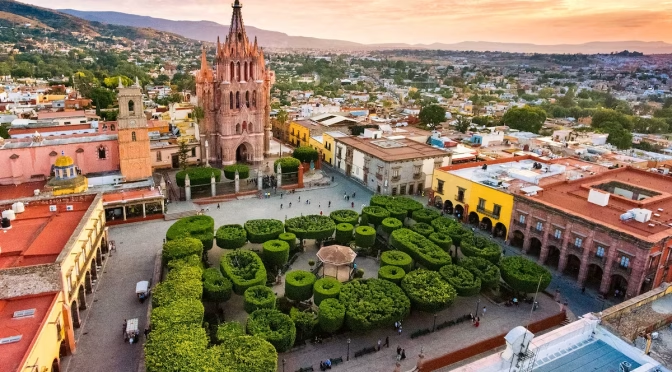
Today, we’ll visit four of the most beautiful and historically significant churches in San Miguel de Allende, all located within a few blocks of Centro. Along the way, we’ll touch on their architectural styles, histories, and why they continue to matter to the life of the city.

San Miguel de Allende is a UNESCO World Heritage Site, renowned for its well-preserved colonial architecture and striking religious buildings. Let’s begin at the heart of it all.

The Parroquia de San Miguel Arcángel

The Parroquia de San Miguel Arcángel is the city’s most iconic structure. The original church dates back to the early 17th century, though it underwent major renovations and expansion in the late 19th century. Its dramatic neo-Gothic façade was redesigned by local architect Zeferino Gutiérrez, who reportedly drew inspiration from European Gothic cathedrals.

The church is constructed from pink cantera, a volcanic stone widely used throughout the city and valued for both its durability and warm tonal variations. This material has become closely associated with San Miguel’s architectural identity.

Inside, visitors will find stained-glass windows, soaring arches, religious artworks, and impressive bell towers that dominate the skyline. Today, the Parroquia is one of the most photographed and recognizable churches in Mexico.

Over the years, the Parroquia has also accumulated its share of local legends and ghost stories — a common fate for historic churches. These tales belong more to popular imagination than documented history, but they add another layer to the building’s mystique, especially when seen at dusk.

Iglesia de la Inmaculada Concepción (Las Monjas)

Located near the Jardín Principal, the Iglesia de la Inmaculada Concepción— often referred to as Las Monjas—is one of the city’s architectural highlights.

Construction began in the mid-18th century, and the church is a fine example of Mexican Baroque architecture. Its most striking feature is the dome, which was inspired by European cathedral design and rises elegantly above the surrounding streets. The façade and dome glow beautifully in the late afternoon light, thanks again to the use of pink cantera stone.
Inside, the church contains richly decorated altarpieces covered in gold leaf, along with artwork created by local craftsmen. The church is dedicated to the Virgin of the Immaculate Conception, reflecting strong Spanish colonial influence in both its architecture and devotional focus.

Each year, the Feast of the Immaculate Conception is celebrated here, drawing a primarily local congregation and reinforcing the church’s role as a living part of San Miguel’s religious life.

Templo de San Francisco
(Corner of San Francisco and Juárez)

The Templo de San Francisco is among the oldest churches in the city. Construction began in 1683 under the direction of Franciscan friars, who played a central role in spreading Christianity throughout the region.

The exterior reflects restrained Baroque design, combining pink stone with white stucco for a striking but understated contrast. Inside, however, the church is far more ornate, featuring a beautifully crafted altar, decorative ceilings, and religious artwork.

While the church itself sits within the bustle of Centro, nearby courtyards and surrounding streets offer quieter moments for reflection. Each year, the Feast of Saint Francis is celebrated in early October, marking one of the church’s most important annual events.

Templo del Oratorio de San Felipe Neri
(Insurgentes 12)

The Oratorio de San Felipe Neri is an excellent example of 18th-century Baroque architecture paired with deep civic and religious significance.

Founded by the Oratorians—a religious order devoted to preaching, education, and community service—construction began in 1748 and was completed in 1753. The church’s elegant façade, carved from local pink stone, features intricate detailing that highlights the craftsmanship of the period. Its bell tower makes it a prominent landmark along Calle Insurgentes.

Inside, visitors will find a finely detailed altar, religious icons, and murals depicting saints and biblical scenes. The Oratorians were instrumental in establishing educational institutions in San Miguel, and their influence extended well beyond the church walls.

The Feast of San Felipe Neri is celebrated each May, maintaining the Oratorio’s role as an active center of worship and community life.

A City of Churches

The churches scattered throughout San Miguel de Allende offer a window into Mexico’s layered history—colonial ambition, religious devotion, artistic expression, and everyday life unfolding over centuries. While it would take weeks to visit them all, these four provide a rich introduction, all within a short walk of Centro.

Enjoy your travels—and take your time.

Michael Solof leads SMA Adventure Hound, a group which takes locals and newcomers to brunches and dinners at different restaurants every week and he also offers classes in the art of smartphone photography. You can contact him at WhatsApp +1-443-310-9214 for more info and to reserve.

Editor’s Letter

By Jane Bauer—

“I’m going to Graceland, Graceland, Memphis, Tennessee
I’m going to Graceland
Poor boys and pilgrims with families
And we are going to Graceland
My traveling companion is nine years old
He is the child of my first marriage
But I’ve reason to believe we both will be received in Graceland”
Paul Simon, singer and songwriter

If you are reading this, you have probably already undertaken a lot of journeys to get here. A pilgrimage is often associated with religion, but there are many other roads than the one to God that lead to salvation. Maybe salvation is too powerful a word for some journeys- communion, perhaps.

It would make sense for this topic to tell of my own journey to my Mexican life almost 30 years ago, but when I think of pilgrimage, I think of a road trip I took with my daughter.

Even though I had already been living in Mexico for close to 15 years, I had several items in Canada that I didn’t want to part with: art my father left me when he died, a few pieces of furniture. We all have things we don’t want to part with just yet. I purchased an old Canada Post truck, filled it up, and my nine-year-old daughter and I took a road trip from Montreal to Huatulco.

It was hot, like driving in a sardine can. The radio didn’t work, but we had an iPod that played music through a speaker. In college, I was briefly obsessed with a book called Reflections on the Birth of the Elvis Faith, which likened the Elvis following to a religious phenomenon. So when my daughter and I found ourselves rumbling along the highway near Memphis, Tennessee, the words to Paul Simon’s Graceland came back to me: “My traveling companion is nine years old.” Without hesitation, we veered towards Graceland.

What back in the 1970s what was considered a mansion now just looked like a large suburban house. I asked people on the shuttle if it was their first time, and for most, it wasn’t. For many, it was an annual pilgrimage; for some, like us, a curiosity. Were we part of the pilgrimage or observers?

We toured the house, and when we reached the Jungle Room, my daughter said, “Like the song.” She meant Walking in Memphis – we had listened to it on some stretch of highway through Ohio.

Saw the ghost of Elvis
On Union Avenue
Followed him up to the gates of Graceland
Then I watched him walk right through
Now security they did not see him
They just hovered ’round his tomb
But there’s a pretty little thing
Waiting for the King
Down in the Jungle Room

As people, journeying, searching, and having faith in something other than our own immediate existence is perhaps the most unifying human experience. Does it really matter if we call this feeling and belief by different names?

See you next month,

Jane

The Year of the Horse

By Roger D. Jones—

There are moments in history when humanity is asked, softly but unmistakably, to remember what it once knew. The horse has always been one of our greatest teachers.
Before machines carried us forward, horses did. Before modern medicine, they carried the wounded. Before therapy had a name, horses regulated our nervous systems with their presence, rhythm, and breath. Across cultures and continents, the horse has symbolized freedom, endurance, sensitivity, and profound intelligence.

Year of the Horse is an invitation to slow down. To listen. To restore a relationship that has quietly suffered in an age of speed and extraction.
Why 2026 Is the Year of the Horse
In the Chinese lunar calendar, 2026 marks the Year of the Horse, beginning with the Lunar New Year in February. In Chinese tradition, the Horse represents energy, intelligence, loyalty, perseverance, and freedom, as well as a deep sensitivity to environment and leadership. The Horse is not ruled through force—it responds to clarity, trust, and mutual respect. When treated well, it gives everything. When misunderstood or pushed beyond its limits, it suffers quietly.

In places like San Miguel de Allende, where tradition, artistry, and community remain deeply woven into daily life—this symbolism feels especially present. Here, the relationship between humans, animals, and land is not abstract, but lived, observed, and felt.
Edgar Cayce and the Future Role of the Horse
The American mystic and healer Edgar Cayce (1877–1945) spoke of a future in which humanity would need to rebalance—between technology and nature, intellect and intuition, power and compassion. In several readings, Cayce suggested that horses would again become essential not as beasts of labor, but as agents of healing, emotional regulation, and spiritual grounding.

Cayce emphasized that horses respond to the inner condition of humans rather than command alone. In this way, they reveal imbalance without judgment and harmony without words. Whether approached as prophecy or symbolism, his insight aligns with both ancient wisdom and modern science: horses help humans remember how to be whole.

Horses as Healers: Living Examples
Across the world, and increasingly here in central Mexico, equine-assisted healing therapies are offering quiet, powerful support to people navigating emotional and neurological challenges.

Autistic children often experience improved emotional regulation, focus, and nonverbal communication when working with horses, whose calm presence and predictable rhythms provide a sense of safety without verbal interaction.

Veterans and first responders coping with post-traumatic stress frequently find that horses respond to their internal state with honesty and without stigma, helping restore trust, confidence, and nervous-system balance.

Individuals dealing with trauma, grief, or major life transitions often report that time spent with horses creates space for presence, emotional release, and reconnection—especially when traditional talk-based therapies fall short.

These outcomes are not based on force or training tricks, but on relationship, consistency, and respect. The Year of the Horse is not a campaign and not owned by any organization or individual. It belongs to anyone willing to approach horses with humility, patience, and respect. You do not need to own a horse to participate. You only need to care.

Editorial Note
For readers wishing to engage directly with equine rescue and education efforts highlighted in this year-long series, visit http://www.EsperanzaEquina.com.

Your Guide to Asian Delights in SMA

By Michael Solof—

This month, in honor of the Chinese Year of the Horse, I want to share a few of my favorite Asian restaurants in SMA. I picked four very different types of restaurants and spoke with the owners and chefs about their establishments and what inspired them to create their own unique spin on Asian cuisine. I selected places with not only varied menus and pricing but also different philosophies and goals.

SPICE MARKET- (Calz. De La Presa 85) 1pm -11:30pm, Daily

Spice Market opened inside the Live Aqua Hotel seven years ago. They specialize in a combination of Indian, Chinese, Japanese, Thai, and Vietnamese foods. Each dish captivates your taste buds while delighting you with beautiful visuals and tantalizing smells. I spoke with Ernesto, the executive chef, and Oscar, the Operations Manager, to get a sneak peek behind the scenes of the restaurant. Spice Market’s dishes are served family-style so that everyone gets involved. The decor feels like you’ve stepped out of Mexico and into an Asian palace. According to Ernesto, Spice Market only uses the finest ingredients, both imported and, as much as possible, locally sourced. Both he and Oscar are especially proud of the service provided in the restaurant. The wait staff offers perfect recommendations after finding out if you have any specific preferences or allergies to any given foods. I love salads, and my waiter recommended the Endive salad with Asian pears, which had a delicious creamy sesame, chili oil-infused takai furikake dressing. The restaurant switches up its menu at least twice a year to keep up with the latest trends and to keep it exciting for returning guests. Ernesto says the key to a great dish is loving what you are cooking and realizing that you are cooking for others and not just yourself. His cooks constantly taste the meals they are prepping to ensure each dish is perfectly flavored. “Cooking is easy to do if you love what you’re doing.”

DRAGON CHINO – (Salida a Celaya 71) 12:30pm – 7pm, Daily

Dragon Chino opened in its current location in 2008 and is the oldest Chinese restaurant in SMA. Over the years, they have developed a devoted local following. The restaurant is small and sparsely decorated, but that’s because the focus is on the dishes they create. I talked with Luis, the owner, and his wife, Lily, who, along with their entire staff, have operated the restaurant since its opening.

A family atmosphere pervades at Dragon Chino, which is open from 12:30 to 7 PM, seven days a week. The menu is packed with well-known and well-loved favorites, as well as a selection of specialty dishes. Luis recommends trying the Peking duck or the crispy orange chicken, which sells the best among long-term customers. “All our food has no MSG, is prepared to order, locally sourced as much as possible, and made with all-natural, fresh ingredients. And the best part is we have an open kitchen, so you can watch as they prepare your meal. It’s lots of fun!” Luis’s words of wisdom are, “Treat your customers like family, and you’ll never go wrong.”

FUNKY PANDA – (Salida a Celaya 16a) 1pm – 9:30pm, Daily

Funky Panda has been open for a year and a half at its current location. Mario, the owner, has big plans and hopes to expand Funky Panda to locations all over Mexico. They are working on opening a new spot in Mexico City early next year. The menu is very varied because Andrea, Mario’s wife and co-owner, likes different types of food than he does, so the menu runs the gamut from sushi to hamburgers. But don’t let those two extremes scare you; the various flavors and tastes are what’s key there, no matter what the dish is.

“We focus on the best ingredients around. All our sauces and salsas are made in-house using traditional family recipes and methods. We respect the past. Some of our recipes are even from my grandmother, who was a famous cook in our neighborhood growing up. For instance, our hamburgers are made by combining three wonderful, yet different types of meat. It may not be the biggest hamburger in town, but I guarantee it’s the most delicious. Many of our ingredients are organic and locally sourced. We’re very proud of the fusion between cultures that we offer, and we love connecting different elements to make unique dishes, all at very affordable prices. I feel you don’t need to be a classically trained chef to succeed; you just have to have a love and a passion for good food and cooking… and everyone here does,” explains Mario.

KOKUMI – (Stirling Dickinson 2) 11am – 8 pm, Closed Wednesdays

There is a brand-new Korean restaurant that opened just over a month ago called Kokumi. When I asked the owner, Aleysha, and her husband, Satoru (who is also the chef), the meaning of the unique name, they stated that it’s a Japanese food-based expression that you say when you eat something wonderful. Kokumi is a sensation of richness, depth, and complexity…and that’s a perfect description for the food they offer. Aleysha was inspired by the fact that her husband is Japanese and they both love Korean food, so they decided to open a Japanese-Korean restaurant but with a goal to go beyond the typical sushi place. They strive to combine traditional Japanese and Korean foods with the warmth of Mexican hospitality. Using many unique ingredients, they make their own kimchi and miso on-site, and bibimbap, Korean BBQ, and shabu-shabu are just some of their specialty dishes. They also love serving Soba noodles because they are not found in many restaurants. Aleysha and Satoru are always looking for ways to reach out to the local community by planning fun, special events and collaborating with other chefs and bartenders. Satoru follows his passion for cooking by starting with a traditional foundation and then innovating it. Aleysha says, “We love this new start and new location, and especially our name… and can’t wait to share our passion for cooking with the community.”

SMA continues to expand its culinary horizons and offerings… and these are just some of the unique culinary experiences that you can enjoy while celebrating the Year of the Horse. I hope to see you at some of these incredible restaurants soon. Each one promises an unforgettable experience that showcases the best of Asian cuisine in SMA.

For those looking to discover more culinary treasures and engage with the local community, I lead *SMA Adventure Hound*, a group that organizes brunches and dinners at various restaurants every week. Additionally, I offer classes in the art of smartphone photography. Feel free to reach out to me via WhatsApp at +1 443–310–9214 for more information and to reserve your spot.

San Miguel’s Oldest No-Kill Shelter: The Lifesaving Work of the S.P.A.

By Megan Gabel—

The Sociedad Protectora de Animales de San Miguel de Allende, A.C. is the oldest no-kill shelter for cats and dogs in San Miguel de Allende. Since 1980, we have provided food, care, and a safe place for stray, abandoned, and homeless animals. Today, we are home to 35 dogs and 20 cats. Our volunteers and staff offer daily love, attention, and support to every animal in our care.

We have a lower-cost in-house clinic with a full-time veterinarian who provides medical care to our shelter animals as well as pets belonging to others in the community. The clinic is open to the public and offers puppy, kitten, and adult wellness packages to keep veterinary costs manageable.

As a no-kill shelter, the S.P.A. is committed to finding homes for all of our animals, no matter how long it takes. We encourage adoptions through a very reasonable all-inclusive adoption fee. Our adoption fee is only 600 pesos, far less than the out-of-pocket costs we incur for tests at intake alone. When we are able to accept an animal, we request a donation to help defray expenses. We are mindful that when a shelter animal is adopted, it saves two lives: the animal who goes home and the one who now has space to come in.

We warmly welcome volunteers and value their help socializing cats and dogs and taking dogs for walks. The feedback we receive from volunteers is extremely positive—they enjoy their time at the S.P.A. and are complimentary about our animals and facilities. The best way to arrange a volunteer visit is to write to info@spasanmiguel.org, so we can exchange information and schedule an interview.

Our adoption process is simple. We encourage potential adopters to explore our website (www.spasanmiguel.org) in advance to see the animals currently available. It’s helpful for us to know who caught their eye and which animals they’re most interested in meeting. Upon arrival, we begin with a brief interview to learn more about the potential adopters and what kind of life they can offer a cat or dog. We also ask what qualities they’re looking for—small, medium, or large dog; male or female; preferred age range; preferred energy level. We know our animals well and can guide adopters toward the best match. Cat adopters are then invited into the cattery, where our adoptions/volunteers coordinator helps them meet potential companions.

For dog adoptions, potential adopters sit in the Jardín, where staff bring out dogs that match their preferences. After each meeting, we ask a few questions to determine whether we’re heading in the right direction. The only time constraint is feeding time, around 1:30 p.m., when dogs are far more interested in their food than in greeting new people. Adoption hours are Monday–Saturday, 11 a.m.–2 p.m.

Once a cat or dog is chosen, the next step is payment of the adoption fee, an optional adoption kit (250 pesos), and an exit exam by our veterinarian. A mandatory free two-week follow-up visit is scheduled, and our Adoption Return Policy is signed.

Although we are not a rescue organization, we do work with rescuers. Maria and Yaba are examples of dogs taken in through rescue partnerships. We frequently receive Facebook messages about abandoned or mistreated animals, with people asking us to send someone out to help. As much as we would like to, the S.P.A. cannot directly intervene—we lack the personnel, finances, and, in some cases, legal authority. Space, particularly for dogs, is extremely limited, and we cannot create room when we are full.

We accept animals from rescuers and Canine Control when space allows. Beyond space, we must also consider health, adoptability, and temperament. Before admitting any animal, our veterinarian performs a thorough exam, including parvo and distemper tests for all dogs. We cannot accept feral cats, and we must assess each animal’s level of socialization before making a final decision.

Mocha and Bonnie are examples of stray dogs now safe at the S.P.A. and waiting for forever homes. Lucky and Jazmin were saved from near-certain death at Canine Control. Litters of homeless kittens—like Ollie, Diego, Zara, and Darcy—have found refuge and warmth with us.

If you encounter abandoned puppies or kittens, we can guide you. It’s a difficult situation—walking away is painful. If you choose to rescue an animal, that animal becomes your responsibility. Call us, and we will let you know if we can take one or more of the animals or offer alternatives. Even when we are full, we can add your rescues to our waiting list.

The S.P.A. is a private non-profit organization. Donations are our only source of income. We receive no government support. Our major annual fundraiser is the Pet Food Money Bank, launched each May to raise the funds needed to feed our shelter animals for the year. Thanks to our generous supporters, we have reached our goal every year since 2015.

Our clinic provides top-quality veterinary services, led by our excellent full-time veterinarian, Dr. Omar Córdova. We offer routine care (checkups and vaccinations), diagnostics, x-rays, lab work, sterilizations, other surgeries, and emergency care. The clinic is open Monday–Saturday from 9 a.m.–3 p.m., and until 4 p.m. on Tuesdays and Saturdays (our discount days). Adoption hours are Monday–Saturday, 11 a.m.–2 p.m.

We are located at Los Pinos 7, near the bus station. Phone: 415-152-6124
.
Visit our website for a map: http://www.spasanmiguel.org
Stop by—we’d love to meet you!

Letter from SMA

By Ximena Collado—

It’s the start of a new year.
This issue has me thinking about new beginnings. Beginnings can be exciting and scary. How do you know when it’s time to start something new? Not everyone has the privilege of starting something new by choice, but for those fortunate enough who do, how can they know?

Enthusiasm toward the desired change must be greater than the comfort of staying where you are now. Comfort can be a beautiful place, but when it starts to quiet your curiosity, it may no longer be serving you. Enthusiasm, on the other hand, carries movement. It propels you forward.

But enthusiasm is not always comfortable. One of the ideas I return to often, inspired by the semiological approach of Alfonso Ruiz Soto, is that what is true is not always what is easy. Real enthusiasm does not necessarily feel light or effortless. It can coexist with fear. It can appear alongside grief for what is being left behind. It can even exist without the approval or understanding of those around you.

And yet, it remains.That persistence is what differentiates enthusiasm from impulse or passing emotion. An impulse burns fast and disappears just as quickly. Semiological enthusiasm stays. It returns quietly, again and again, even when doubt is present. Even when the path is unclear. Even when staying where you are would be simpler.

Enthusiasm is not a promise of ease or success. What it offers instead is direction. It functions as a compass, not a map. It doesn’t explain every step, but it consistently points somewhere meaningful.

So how do you know what to start? Follow what genuinely enthuses you—not only what excites you in the moment, but what continues to call your attention over time. Follow what feels alive, even if it feels inconvenient. Often, clarity does not come before movement. It comes after the first small step, once you allow yourself to begin.

Thank you tosome of the people who have helped me and opened their doors to me with this new project.

Roger Jones, our dear family friend, who always takes the time to welcome us at his breakfast table at his beautiful boutique hotel, Casa Angelitos.

Susana Alonso, an incredible glass artist with whom I spent hours talking at her studio and who made me feel completely at home.

Mike Solof, one of our incredible writers, who simply brings me so much joy.

To everyone who is reading this issue and who read the previous one, thank you. I wish you a beautiful start to 2026.Let’s start this Year of the Horse with strength, fire, and enthusiasm.

See you in February,
Ximena Collado

The Story of San Miguel Shoes

By Ximena Collado—

Walking through the cobbled streets of San Miguel de Allende, it’s easy to believe that memory has a sound—the soft percussion of footsteps on stone, the hum of voices carried by warm air, the slow rhythm of a town that still takes its time. Somewhere in that rhythm lives the story of Don Santiago and Martha, two dreamers whose love gave life to San Miguel Shoes. For them, every pair was more than footwear—it was affection made tangible, a way of stitching home and heart into something you could carry wherever you went.

More than twenty years ago, Don Santiago arrived from León, a shoemaker in search of a new beginning. He found it in San Miguel de Allende, its light, its color, and the woman who would become his lifelong companion, Martha. Together, they imagined shoes that would accompany people through their days – comfortable, enduring, and made with care. The first sandal he crafted for her wasn’t just built to withstand the uneven stones of the city; it became a symbol of their life together – steady, resilient, and full of quiet devotion. Their dream soon grew into a small workshop where every design was shaped with patience and purpose. Each pair was meant to last—to travel through years and stories, just as Santiago and Martha did, side by side.

That same spirit still guides San Miguel Shoes today. Now led by their children, the brand has evolved without losing its soul. The workshop hums with the rhythm of more than fifty artisans, most of them women, whose skill and dedication have turned comfort into an art. From the start, sustainability wasn’t a slogan—it was instinct. Every process is designed to minimize waste, every material chosen for comfort, flexibility, and responsibility.

These shoes aren’t made of leather but of soft, adaptive fabrics that move naturally with the foot. Their light yet durable structure provides a sense of ease and stability, offering the kind of comfort that makes each step confident—even across the cobblestones of San Miguel. Women who wear them often describe the same feeling: a secure, effortless stride that carries them through long days without strain or hesitation. The shoes are made not for fleeting trends but for real lives—workdays, travels, and moments in motion.

Created for women of all ages, San Miguel Shoes blend versatility with timeless style. These are shoes made for real life, practical yet elegant, refined yet easy to wear. Every design reflects the brand’s belief that true luxury lies in quality, comfort, and longevity.

Color, too, plays its part, not as fashion, but as expression. Each year, San Miguel Shoes introduces a new palette inspired by the town itself: the soft blush of morning walls, the golden tones of afternoon light, the earthy reds of sunset. For 2026, the collection turns toward teal, blues, and green tones that capture the freshness of water and the calm of shade on a bright day.

Beyond their beauty, San Miguel Shoes sustains a community. The brand provides dignified work, preserves ancestral techniques, and empowers women who have become masters of their craft. Each pair is unique, an imprint of many hands, shaped by patience and pride. And at the heart of it all remains the story of Don Santiago and Martha. Both passed away during the pandemic, only a month apart. Those who knew them say their love was simply too strong to be separated. Their spirit walks on in every shoe, in every step taken by those who wear them.

Today, anyone can take a piece of that story on their own journey. Each pair is a promise, made to last a lifetime, just like the love of Don Santiago and Martha.
http://www.sanmiguelshoes.com.mx

The San Miguel Writers’ Conference and Literary Festival 2026

By Pat Steele—

The San Miguel Writers’ Conference and Literary Festival began in 2006 as an event attended by just 26 people. But what a difference two decades makes. Celebrating its twenty-first anniversary next year, it now brings 1,500 visitors to the mountain town in the heart of Mexico that Travel + Leisure magazine readers have repeatedly voted the “number one city in the world.”

“Our goal is to bring together the literary traditions of the US, Canada, and Mexico,” said the organization’s executive director, Jodi Pincus. “But as we continue to grow, we also have an increasingly global outlook. We strongly believe in the power of literature to build bridges by telling people’s stories. And there’s never been a greater need for that.”

The charm, culture and people of San Miguel de Allende are all parts of the reason why world-famous authors make the trip here each year. Keynoting the 2026 conference, which will be held February 11—15 at the Hotel Real de Minas, are global superstar writers Abraham Verghese (Cutting for Stone; The Covenant of Water), Chimamanda Ngozi Adichie (Half of a Yellow Sun; Americanah; Purple Hibiscus), Rebecca “R.F.” Kuang (The Poppy War trilogy; Babel; Yellowface), Emily St. John Mandel (Station Eleven; The Glass Hotel; Sea of Tranquility), Andrés Neuman (Bariloche; Traveler of the Century; Fracture; Until It Begins To Shine) Yásnaya Elena Aguilar Gil (Ää: Manifiestos por la diversidad lingüística), Maira Kalman (The Principles of Uncertainty), and the winner of Canada’s prestigious Giller Prize for fiction (to be announced.)

Sandra Cisneros (The House on Mango Street, Woman Hollering Creek and Other Stories) and Eduardo Antonio Parra (Nostalgia de la sombra, El rostro de piedra) are two famous names among the dozens of conference faculty who will be offering lectures, advice, and hands-on courses. Attendees will be able to take workshops in everything from plotting telenovelas to writing their memoir. Other faculty members of note include Jean Kwok, Jennifer Clement, Ann Hood, Hope Edelman, Christopher Bollen, and Sara Weinman.

The conference is also a great place for would-be authors to get practical advice from experts on the business and publishing side of literature. Prominent literary agents such as Michael Carr, Anna Knutson Geller, Rita Rozenkranz, Veronica Flores, Sam Hiyate and Susan Golomb will offer one-on-one pitch sessions. Other top publishing insiders offering individual consultations include Harper Influence publisher, Lisa Sharkey. There are also parties galore, faculty readings, open mic sessions, guided local excursions, discussion groups, wellness offerings, and more.

The conference is almost fully bilingual, and many of the Spanish-langue events are free to Mexican nationals. The general director of the Spanish program is Armida Zepeda, who has been instrumental in bringing many famous writers from Mexico and Latin America to San Miguel. “As a culture promoter, I know the literary scene in Mexico, which allows me to interact with literary professionals whom I am thrilled to invite to the festival,” she said.

Prominent Mexican and Spanish-language teaching faculty next year will include Amaranta Caballero, Ana Luisa Isla, Araceli Ardón, Bernardo Govea, Marcela R. Loreto, Mónica Hoth, Rodrigo Díaz Guerrero, Josemaria Moreno, Antolina Ortiz Moore, Matthew Sanabria Stenger, and Magali T. Ortega.

Many credit the event’s president and co-founder, Susan Page, as being among the secrets to its success. “I organized my Brownie troop in the third grade and have been starting organizations ever since,” she jokes. “The Writers’ Conference has put San Miguel on the literary map of the world and brings over three million US dollars into the local economy every year. Plus, I love the experience itself: high-level thrills combined with intimate connections. It’s an enchanting week.”

Her considerable charm and commitment to literature have brought a who’s-who of famous writers to the conference over the last 20 years. Just a small selection of those names include John Irving, Margaret Atwood, Barbara Kingsolver, Cristina Rivera Garza, Silvia Moreno Garcia, Gloria Steinem, Judy Collins, Alice Walker, Scott Turow, Joyce Carol Oates, Calvin Trillin, Yuri Herrera, Rosa Beltrán, Margo Glantz, Pedro Ángel Palou, Brenda Lozano, Guillermo Arriaga, Adam Gopnik, Elena Poniatowska, Laura Esquivel, Mary Karr, Juan Villoro, Jorge Volpi, Tommy Orange, Paul Theroux, and Delia Owens. (You might also recognize Page’s name as the author of the international bestseller “If I’m So Wonderful, Why Am I Still Single?”—first published in 1988, and still going strong.)

Tom Robbins, the late counterculture icon whose novels include Even Cowgirls Get the Blues, was an early supporter, keynoting the conference in 2008. Before going home he left a testimonial for the fledgling event, which was then still only catering to a few dozen people: “If Dante had had the San Miguel experience, he would have written more about heaven and less about hell.”

For tickets and more information about the program, please visit the ‘ San Miguel Writers Conference and Literary Festival website: http://www.sanmiguelwritersconference.org