
Tag Archives: April 2016
Editor’s Letter
 “Have you also learned that secret from the river; that there is no such thing as time?” That the river is everywhere at the same time, at the source and at the mouth, at the waterfall, at the ferry, at the current, in the ocean and in the mountains, everywhere and that the present only exists for it, not the shadow of the past nor the shadow of the future.”
― Hermann Hesse, Siddhartha
I was born on an island in the middle of a great raging river that once upon a time flowed majestically out to the Atlantic Ocean. The island was so large that it was easy to forget it was bordered by water. We didn’t spend Sundays sitting on its banks having picnics and swimming or depend on it for food. We crossed over the river on large concrete bridges, safely ensconced in our cars, barely acknowledging the dark murky waters below. Continue reading Editor’s Letter
LA BIBLIOTECA DEL MAR A Library and Community Center by the Sea
 By Geri Anderson
Bumping along the narrow country road twelve kilometers from the all-inclusive beach resorts of Bahias de Hualtuco, you wouldn’t expect to end up in one of the most idyllic places in the state of Oaxaca. A few cows graze in roadside pastures, and you’ll pass a banana plantation and acres of tended trees in a reforestation project. A grove of palms will be harvested for palapas and another patch of palms, heavy with coconuts, provide coco milk and sweet coco meat. Here and there splashes of graffiti brighten rocky cliffs. Continue reading LA BIBLIOTECA DEL MAR A Library and Community Center by the Sea
Hello Westjet!
 By Cindy Belyk
On December 12, 2015, Westjet introduced direct service from Calgary, Alberta (YYC) to Huatulco, Mexico (HUX). This announcement was thrilling for a lot of us Western Canadians. Finally an easy connection from small towns in BC, Alberta and Saskatchewan to Westjet’s hub in Calgary. From Calgary, a six hour flight on a non-charter airline. Continue reading Hello Westjet!

Mexico City’s Best Kept Secret: The “Other” Diego Rivera Murals
By Carole Reedy—
They really aren’t a secret, per se, as they appear in just about every guidebook’s top-ten list. But even though they’re located in mero Centro Histórico, in the building of the Secretaría de Educación Pública (República de Argentina 28), just a block from the Templo Mayor, this series of Rivera murals is often missed by visitors and residents alike. Even by foreigners who have lived in the megalopolis for more than 40 years!
It’s quite a mystery, and one for which I don’t have a sensible answer. Upon seeing the murals for the first time, “Why have I never seen these before?” is a common response.
Just a few blocks away sits the National Palace, housing Rivera’s famous sweeping mural (1929–35), which hugs the grand staircase and continues along the second-floor corridors. Rivera began work on the murals in the Education Building in 1923, completing the project in 1928. The building itself occupies a former convent complex dating from the colonial period.
Today, the building is home to the Museo Vivo del Muralismo, which opened in 2024 following restoration work. Visitors can explore the murals and additional exhibition spaces Wednesday through Monday, from 10 am to 6 pm. Admission is free. Unlike the old government-building arrangement, the museum now welcomes visitors on weekends. Check current arrangements before setting out, particularly on holidays.
At the Secretaría de Educación building, dozens of Diego Rivera murals flow across three floors, enough to put visitors in a tizzy. Take your time to view them all. The ground floor is dedicated largely to the traditions and daily lives of the people of Mexico, including religious and political festivals. The second level explores themes of work, knowledge and social life. On the third level, my favorite, you’ll find powerful images of labor and revolutionary struggles.
A red ribbon floats above a series of murals where the sentiments of revolutionary corridos are written, including The Ballad of Zapata, Agrarian Revolution of 1910 and Thus Will Be the Proletarian Revolution. The allegorical murals are a scathing criticism of the rich and opponents of the Revolution. Favorites include The Arsenal, depicting Frida Kahlo distributing arms to revolutionaries, and another showing a fancy dinner party where wealthy diners are served gold.
When you visit the murals in the Secretaría de Educación, I highly recommend you start or complete your visit at El Mayor terrace restaurant, just half a block away, at the corner of Donceles and República de Argentina. This seems to be another spot overlooked by both tourists and residents of Mexico.
The terrace itself is located above a large Porrúa bookstore. Find the elevator that will take you directly to the restaurant. Here you can sip a glass of wine or cappuccino while enjoying a relaxing breakfast or lunch and contemplating the Templo Mayor Aztec ruins below, with the Zócalo just beyond.
Looking to the right, the view is dominated by the huge cathedral the Spanish built near the ruins of the Aztec ceremonial precinct, an architectural imposition repeated throughout Mexico. (On one of your visits to this most diverse of countries, be sure to head toward Cholula, Puebla, where you can visit the church above ground and explore the ancient pyramid beneath it.)
Diego Rivera is one of the best-known and most renowned muralists of the twentieth century. His works are recognized as masterpieces depicting the lives and struggles of Mexican people. While studying in Europe, he was influenced by Cubism as well as the murals of Italy. The Mexican and Russian Revolutions were passions of Rivera and his famous wife, Frida Kahlo. Rivera’s murals grew out of these political convictions and the couple’s involvement in Communism.
A visit to the National Palace, located on the Zócalo, is also worthwhile when public access is available. Visits to Rivera’s murals may require advance registration and can be affected by official activities, so confirm arrangements before going. Here the painted history of Mexico and the struggles of the Mexican people line the stairway to the second floor, where the murals continue. The blend of colors, both bright and muted, the details of the faces and the rolling landscapes transport you to different periods in the turbulent history of the country.
The Palacio de Bellas Artes houses one of Rivera’s most famous murals, Man, Controller of the Universe, painted in 1934. This work reimagines the mural commissioned by the Rockefeller family and destroyed in New York after controversy erupted over Rivera’s inclusion of Communist leader Vladimir Lenin.
Frida’s Blue House in the neighborhood of Coyoacán is a tourist’s delight, filled with her and Diego’s paintings, personal rooms and her studio. She and Diego lived here for many years, as did Leon Trotsky for a short period before moving to another home just a few blocks away. Be sure to visit Trotsky’s home, too, the place where he was assassinated. Advance tickets are recommended for the Blue House.
In the neighboring colonia of San Ángel, near the San Ángel Inn, Rivera’s art studio and the adjoining houses of Frida and Diego are open to visitors. You may recall that at one point in the topsy-turvy relationship of the pair, they lived in separate houses connected by a bridge.
Regardless of how often you visit Ciudad de México, something new awaits, very often just around the corner.
Visitor information: Museo Vivo del Muralismo, República de Argentina 28, Centro Histórico. museovivodelmuralismo.sep.gob.mx
Recap of The Blues
By Brooke Gazer
This year’s “Blues on the Beach” concerts set new attendance records with 610 attendees in January and 630 the following month. In January, the energy level set by Enrico Crivellaro and Brian Templeton was a hard act to follow. However, with Jack DeKeyzer, Cheryl Lescom, Jerome Godboo and Chuckee Zehr all sharing the same stage, the bar was raised yet another notch. I can’t wait until 2017 to see how they plan to top this. Continue reading Recap of The Blues
A Primer on Pulque: Harvesting Aguamiel
 By Alvin Starkman, M.A., J.D.
We arrive in the fields about 5:30 pm, near the foothills of the Sierra Madre del Sur, trying to catch the final glimmer of light before dusk sets in. I’ve invited a group of Oaxacan friends to accompany me and my native Zapoteco amigos Juana, Andrés and two of their children, into the countryside to witness the harvesting of aguamiel from the majestic Agave americana. The plant is commonly known as pulquero, because it’s the main species used to make pulque in Santiago Matatlán. And that’s the motive for the trek; even Oaxacans rarely if ever have had an opportunity to learn about pulque production first hand, out amongst the towering rows of maguey (agave). Continue reading A Primer on Pulque: Harvesting Aguamiel
Mayan Mysteries and the Usumacinta River
 By Deborah Van Hoewyk
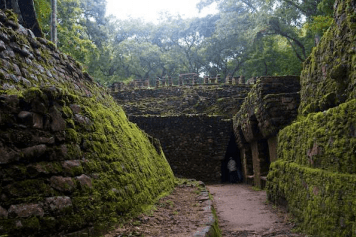
Oh, those mysterious Maya! Google “mystery” and Maya” and in less than half a second, you get more than 12 million hits. There are lots of little mysteries, being solved every day by archaeologists and anthropologists working in the Mayan ruins spread across what is now Chiapas, the Yucatán, Belize, Guatemala, and the western borders of Honduras and El Salvador. To the Maya, we owe the wonders of Chichén Itzá (Yucatán), Palenque (Chiapas), Tikal (Guatemala), Caracol (Belize), Copán (Honduras), and hundreds more places where ancient stones rise out of hillocks in the tropical jungle. Continue reading Mayan Mysteries and the Usumacinta River
Bottoms Up in Marina Chahué

By Jan Chaiken and Marcia Chaiken
Can you imagine that at one time Rio Chahué flowed vigorously and majestically down from the mountains north of Crucecita to Chahué Beach and from there to the Pacific Ocean? Although now there is a bridge labelled “Rio Chahue” on the highway from the airport to Salina Cruz, at this season of the year the bridge crosses over a dry river bed. South of the highway, and all the way through town, the river bed is now a mundane concrete channel, dividing roads such as Tamiagua and Guelaguetza into two one-way corridors on either side of the concrete watercourse. The channelled Rio Chahué passes by the Marina Park Plaza Condo Hotel and then flows under a handsome bridge where it reaches its ignominious end at a dam. Continue reading Bottoms Up in Marina Chahué
Rattlesnakes and Scorpions
By Kary Vannice
The rivers of Mexico offer a tremendous amount of variety for aquatic enjoyment. You can partake of whitewater rafting, fishing, swimming, mangrove exploration; there’s an almost endless list of ways to experience their watery depths. Continue reading Rattlesnakes and Scorpions
You must be logged in to post a comment.